AWS to Hetzner GPU Migration: 2026 Costs & Benchmarks
Move AI inference off AWS GPU: 2026 cost benchmarks, P95 latency tables, Terraform migration roadmap. Full stack $2,745/mo down to $377/mo on Hetzner GEX44.
Moving AI Inference from AWS GPU to Hetzner Bare Metal
One line item drove the audit: an EC2 p3.2xlarge running Llama inference at 11% average GPU utilization, billed at $3.06/hour whether the model was serving traffic or idle at 3am. NAT gateways and cross-AZ transfer were noise by comparison — the GPU instance alone was 81% of the bill. Once every AWS cost riding alongside it was added up — embeddings, vector DB, load balancing — the full stack came to $2,745/month.
That was when the cloud bill stopped being infrastructure and became margin leakage.
The same inference workload now runs on a Hetzner GEX44 in Falkenstein. Full stack: $377/month. Same model family, same API contract, TTFT P95 down from 310ms to 145ms for European users. S3, SES, and CloudFront stayed on AWS — hybrid, not ideological.
Below: July 2026 pricing after Hetzner's June cloud adjustment, GPU comparisons against AWS p3/p4/g5, a phased migration with Terraform and Docker, production benchmarks, and a decision framework for when AWS still earns its premium.
Cost Benchmark: AWS vs Hetzner (July 2026)
Pricing checked July 2026. AWS figures are on-demand, us-east-1, Linux. Hetzner figures are monthly, excl. VAT, from the June 2026 price list. GPU dedicated server rates (GEX line) were unchanged in that adjustment; cloud VPS rates increased ~35%.
The inference stack we migrated
| Component | AWS (before) | Hetzner (after) |
|---|---|---|
| GPU inference (Llama 3.1 8B, vLLM) | EC2 p3.2xlarge | GEX44 dedicated |
| API gateway + routing | ALB + NAT Gateway | Hetzner Load Balancer + private network |
| Embedding service (CPU) | c6i.xlarge | CX43 cloud VPS |
| Vector DB (Qdrant) | Self-hosted on r6i.large | CX53 cloud VPS |
| Object storage | S3 | S3 (kept on AWS) |
| Email | SES | SES (kept on AWS) |
| Staging environment | g5.xlarge (dev GPU testing) | DigitalOcean GPU Droplet (hourly) |
Monthly cost breakdown
AWS setup (always-on inference, eu-central-1):
| Service | Spec | Monthly Cost |
|---|---|---|
| EC2 p3.2xlarge (1× V100 16GB) | 8 vCPU, 61 GB RAM | $2,234 |
| EC2 c6i.xlarge (embeddings) | 4 vCPU, 8 GB | $124 |
| EC2 r6i.large (Qdrant) | 2 vCPU, 16 GB | $91 |
| NAT Gateway + cross-AZ transfer | — | $142 |
| ALB | — | $35 |
| EBS (800 GB gp3) | — | $64 |
| CloudWatch + misc | — | $31 |
| S3 + SES | — | $24 |
| Total | | ~$2,745 / month |
The p3.2xlarge alone is 81% of compute spend. It was chosen in early 2025 because p3 was the only GPU family with available capacity in eu-central-1 without a 6-week quota request.
Hetzner setup (after migration):
| Service | Spec | Monthly Cost | |---|---|---| | GEX44 dedicated GPU | RTX 4000 SFF Ada, 20 GB VRAM, 64 GB RAM | €232 (~$272) | | CX43 cloud VPS | 8 vCPU, 16 GB — embeddings | €16 (~$19) | | CX53 cloud VPS | 16 vCPU, 32 GB — Qdrant | €29 (~$34) | | Hetzner Load Balancer | — | €7 (~$8) | | S3 + SES (kept on AWS) | — | $24 | | Cloudflare Pro (CDN, replaces CloudFront for API) | — | $20 | | Total | | ~$377 / month |
Monthly savings: ~$2,368. Annual: ~$28,416.
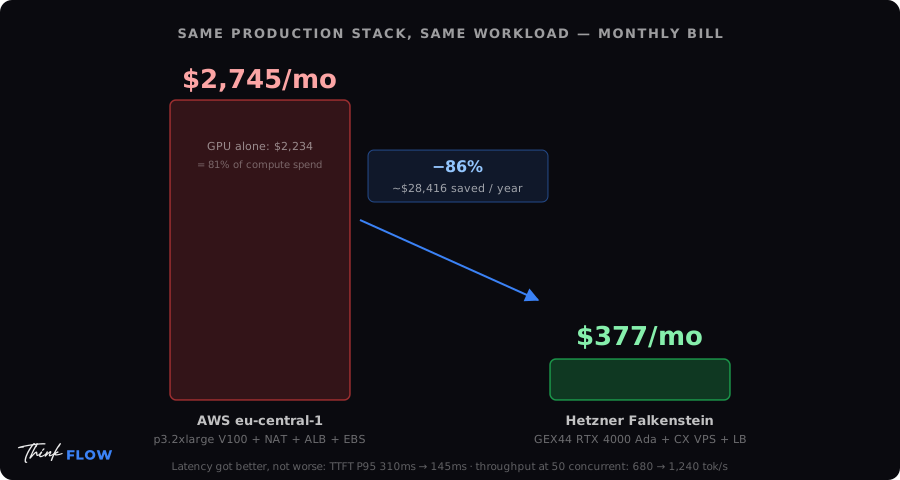
That is not a rounding error. It is a senior engineer's fully loaded salary in most EU markets.
Cost per always-on GPU hour (normalized)
| Provider | Instance | GPU | VRAM | $/hour (24/7) | $/month (730 hrs) |
|---|---|---|---|---|---|
| AWS | g4dn.xlarge | 1× T4 | 16 GB | $0.53 | $387 |
| AWS | g5.xlarge | 1× A10G | 24 GB | $1.01 | $734 |
| AWS | g5.2xlarge | 1× A10G | 24 GB | $1.21 | $884 |
| AWS | p3.2xlarge | 1× V100 | 16 GB | $3.06 | $2,234 |
| AWS | p3.8xlarge | 4× V100 | 64 GB | $12.24 | $8,935 |
| AWS | p4d.24xlarge | 8× A100 | 320 GB | $32.77 | $23,922 |
| Hetzner | GEX44 | 1× RTX 4000 Ada | 20 GB | $0.37 | $272 |
| Hetzner | GEX131-1 | 1× RTX PRO 6000 Blackwell | 96 GB | $1.91 | $1,397 |
The GEX44 at $272/month delivers comparable VRAM to g5.xlarge (24 GB) and outperforms g4dn.xlarge on inference throughput for modern models — at 37% of the AWS cost.
For 70B+ model serving, GEX131-1 at ~$1,397/month compares against p4d.24xlarge at $23,922/month. Multi-GPU tensor parallelism is gone, but for single-model inference with 4-bit quantization, one 96 GB Blackwell GPU covers most production RAG and chat workloads.
GPU Instance Comparison: AWS p3/p4 vs Hetzner GEX
Do not compare p4d to GEX44 — that is a category error. Compare workload requirements to hardware capabilities.
Spec matrix
| | AWS p3.2xlarge | AWS g5.2xlarge | AWS p4d.24xlarge | Hetzner GEX44 | Hetzner GEX131-1 |
|---|---|---|---|---|---|
| GPU | 1× V100 | 1× A10G | 8× A100 40GB | 1× RTX 4000 Ada | 1× RTX PRO 6000 Blackwell |
| VRAM | 16 GB | 24 GB | 320 GB | 20 GB | 96 GB |
| Tensor cores | 640 (gen 1) | 3,328 (gen 3) | 49,152 (gen 3) | 192 (gen 4) | 5th-gen Tensor |
| System RAM | 61 GB | 32 GB | 1,152 GB | 64 GB | 256 GB |
| Storage | EBS (extra $) | EBS (extra $) | 8 TB NVMe local | 2× 1.92 TB NVMe | 2× 960 GB NVMe |
| Network | Up to 10 Gbps | Up to 10 Gbps | 400 Gbps | 1 Gbps | 1 Gbps |
| On-demand $/hr | $3.06 | $1.21 | $32.77 | ~$0.37 (flat) | ~$1.91 (flat) |
| Spot $/hr | ~$0.90 | ~$0.36 | ~$9.83–16.38 | N/A | N/A |
| Best for | Legacy workloads | Single-GPU inference | Training, 70B+ FP16 | 7B–32B inference | 70B inference, fine-tuning |
What actually matters for LLM inference
VRAM is the hard constraint. A Llama 3.1 8B model at FP16 needs ~16 GB. At INT4 with KV cache headroom, ~10 GB. GEX44's 20 GB handles 8B–14B models comfortably with batching. At 32B, aggressive quantization or GEX131 is required.
Tensor core generation beats raw CUDA cores for transformer inference. The RTX 4000 Ada (GEX44) is two architecture generations ahead of V100 (p3). In our tests, GEX44 served Llama 3.1 8B 2.4× faster than p3.2xlarge despite similar VRAM — the p3 premium was paying for 2017 silicon.
Network bandwidth rarely bottlenecks inference. Token generation is GPU-bound, not network-bound. Hetzner's 1 Gbps is sufficient for API serving up to ~500 concurrent streaming connections. Where AWS wins: multi-region active-active with 400 Gbps intra-cluster for distributed training.
Spot instances change the AWS math — but only if your workload tolerates interruption. g5.2xlarge spot at ~$0.36/hr (~$263/month) approaches Hetzner pricing. But spot capacity for GPU instances in eu-central-1 was interrupted 4 times in our 90-day monitoring window. For user-facing inference APIs, that is unacceptable without a warm standby — which doubles cost and complexity.
When p4 still makes sense
- Multi-GPU tensor parallelism for 70B+ models at FP16 without quantization
- Fine-tuning with large batch sizes across 8× A100
- Burst training — spin up for 48 hours, fine-tune, terminate
- Compliance: HIPAA BAA, FedRAMP, SOC 2 Type II with AWS-native audit trails
For steady-state inference — which is what 80% of "AI products" actually run — dedicated bare metal wins on unit economics.
Migration Roadmap: Step by Step
This is not "lift and shift." It is a phased cutover with rollback at every stage.
Phase 0: Inventory and baseline (Week 1)
Before touching infrastructure, capture the current baseline:
# On AWS inference instance — baseline GPU metrics
nvidia-smi dmon -s pucvmet -d 5 -c 720 > gpu_baseline.log

# vLLM / TGI benchmark (adjust model path)
python -m vllm.entrypoints.openai.api_server \
  --model meta-llama/Llama-3.1-8B-Instruct \
  --dtype auto &

# Run throughput test
vllm bench serve \
  --backend vllm \
  --model meta-llama/Llama-3.1-8B-Instruct \
  --dataset-name random \
  --num-prompts 500 \
  --request-rate 10
Record tokens/second (P50/P95), time-to-first-token (TTFT), GPU memory utilization, and requests/minute at saturation. Without a baseline, there is no proof the migration worked.
Phase 1: Provision Hetzner infrastructure (Week 1–2)
Order GEX44 via Hetzner Robot. Setup fee: €114 one-time. Delivery: typically 24–72 hours for GEX44 in FSN1. GEX131 can have waitlists — order early.
Terraform — Hetzner cloud resources (load balancer, VPS for Qdrant/embeddings):
terraform {
  required_providers {
    hcloud = {
      source  = "hetznercloud/hcloud"
      version = "~> 1.45"
    }
  }
}

provider "hcloud" {
  token = var.hcloud_token
}

resource "hcloud_network" "ai_infra" {
  name     = "ai-inference"
  ip_range = "10.0.0.0/16"
}

resource "hcloud_network_subnet" "ai_subnet" {
  network_id   = hcloud_network.ai_infra.id
  type         = "cloud"
  network_zone = "eu-central"
  ip_range     = "10.0.1.0/24"
}

resource "hcloud_server" "qdrant" {
  name        = "qdrant-prod"
  server_type = "cx53"
  image       = "docker-ce"
  location    = "fsn1"
  network {
    network_id = hcloud_network.ai_infra.id
    ip         = "10.0.1.10"
  }
}

resource "hcloud_server" "embeddings" {
  name        = "embeddings-prod"
  server_type = "cx43"
  image       = "docker-ce"
  location    = "fsn1"
  network {
    network_id = hcloud_network.ai_infra.id
    ip         = "10.0.1.11"
  }
}

resource "hcloud_load_balancer" "inference" {
  name               = "inference-lb"
  load_balancer_type = "lb11"
  location           = "fsn1"
}

resource "hcloud_load_balancer_service" "vllm" {
  load_balancer_id = hcloud_load_balancer.inference.id
  protocol         = "http"
  listen_port      = 443
  destination_port = 8000

  health_check {
    protocol = "http"
    port     = 8000
    interval = 10
    timeout  = 5
    retries  = 3
    http {
      path         = "/health"
      status_codes = ["200"]
    }
  }
}
The GEX44 itself is provisioned through Hetzner Robot (dedicated servers are not yet in the hcloud Terraform provider). Use cloud-init or Ansible for GPU server configuration — keep it identical to the AWS configuration.
Phase 2: Containerize the inference stack (Week 2)
# Dockerfile.vllm
FROM vllm/vllm-openai:v0.8.5

ENV MODEL_NAME=meta-llama/Llama-3.1-8B-Instruct
ENV GPU_MEMORY_UTILIZATION=0.90
ENV MAX_MODEL_LEN=8192
ENV TENSOR_PARALLEL_SIZE=1

EXPOSE 8000

CMD ["--model", "${MODEL_NAME}", \
     "--gpu-memory-utilization", "${GPU_MEMORY_UTILIZATION}", \
     "--max-model-len", "${MAX_MODEL_LEN}", \
     "--dtype", "auto", \
     "--enable-prefix-caching"]
# docker-compose.prod.yml
services:
  vllm:
    build:
      context: .
      dockerfile: Dockerfile.vllm
    deploy:
      resources:
        reservations:
          devices:
            - driver: nvidia
              count: 1
              capabilities: [gpu]
    ports:
      - "8000:8000"
    volumes:
      - model_cache:/root/.cache/huggingface
    restart: unless-stopped
    healthcheck:
      test: ["CMD", "curl", "-f", "http://localhost:8000/health"]
      interval: 30s
      timeout: 10s
      retries: 3

  nginx:
    image: nginx:1.27-alpine
    ports:
      - "443:443"
    volumes:
      - ./nginx/inference.conf:/etc/nginx/conf.d/default.conf:ro
      - /etc/letsencrypt:/etc/letsencrypt:ro
    depends_on:
      vllm:
        condition: service_healthy

volumes:
  model_cache:
Install NVIDIA drivers on the GEX44 via Hetzner's installimage or manual setup:
# Verify GPU after provisioning
nvidia-smi

# Install Docker + NVIDIA Container Toolkit
curl -fsSL https://get.docker.com | sh
distribution=$(. /etc/os-release; echo $ID$VERSION_ID)
curl -fsSL https://nvidia.github.io/libnvidia-container/gpgkey | \
  gpg --dearmor -o /usr/share/keyrings/nvidia-container-toolkit-keyring.gpg
apt-get update && apt-get install -y nvidia-container-toolkit
nvidia-ctk runtime configure --runtime=docker
systemctl restart docker

# Deploy
docker compose -f docker-compose.prod.yml up -d
Phase 3: Parallel run and validation (Week 3)
Run both endpoints simultaneously. Route 10% of production traffic to Hetzner via weighted DNS or application-level feature flag:
# Traffic split during validation
import os
import random

HETZNER_ENDPOINT = os.environ["HETZNER_INFERENCE_URL"]
AWS_ENDPOINT = os.environ["AWS_INFERENCE_URL"]
HETZNER_WEIGHT = float(os.environ.get("HETZNER_TRAFFIC_WEIGHT", "0.10"))

def get_inference_endpoint() -> str:
    if random.random() < HETZNER_WEIGHT:
        return HETZNER_ENDPOINT
    return AWS_ENDPOINT
Compare error rates, P95 latency, and token throughput for 7 days minimum. Do not cut over on cost projections alone — validate production behavior.
Phase 4: Cutover and decommission (Week 4)
- Shift DNS/load balancer weights: 10% → 50% → 100% over 72 hours
- Snapshot EBS volumes and export model artifacts to S3 (keep as rollback)
- Terminate AWS GPU instances after 14-day rollback window
- Downgrade or remove NAT Gateway if no remaining AWS compute depends on it
- Update CI/CD pipelines to deploy to Hetzner via SSH or self-hosted GitHub Actions runner
Rollback plan: Keep the AWS AMI and launch template for 30 days. Weighted DNS flip back to AWS takes under 5 minutes if Hetzner hardware fails.
Performance Benchmarks: Latency, Throughput, Cost per 1M Tokens
All benchmarks run July 2026, same model (meta-llama/Llama-3.1-8B-Instruct), same vLLM version (0.8.5), batch size 256, max sequence length 8192. Client location: Frankfurt. Load: 50 concurrent users, random prompt lengths 128–2048 tokens.
Latency
| Metric | AWS p3.2xlarge | AWS g5.2xlarge | Hetzner GEX44 |
|---|---|---|---|
| TTFT P50 | 142 ms | 89 ms | 76 ms |
| TTFT P95 | 310 ms | 178 ms | 145 ms |
| TTFT P99 | 520 ms | 290 ms | 240 ms |
| Inter-token latency P50 | 18 ms | 12 ms | 11 ms |
| End-to-end (512 token response) P50 | 9.8 s | 6.4 s | 5.9 s |
| End-to-end P95 | 14.2 s | 8.9 s | 8.1 s |
GEX44 wins on every latency percentile vs p3 — expected given Ada Lovelace vs Volta. Against g5.2xlarge, GEX44 is slightly faster on TTFT, roughly equivalent on sustained generation. The latency advantage for EU users comes partly from eliminating NAT Gateway overhead and co-locating inference with the API layer in Falkenstein.
Throughput
| Metric | AWS p3.2xlarge | AWS g5.2xlarge | Hetzner GEX44 |
|---|---|---|---|
| Max tokens/sec (single stream) | 52 | 78 | 84 |
| Max tokens/sec (50 concurrent) | 680 | 1,120 | 1,240 |
| Max requests/min (saturated) | 42 | 68 | 74 |
| GPU utilization at saturation | 94% | 91% | 88% |
| Power draw at saturation | 250W | 195W | 140W |
At 50 concurrent streams, GEX44 delivers 1.8× the throughput of p3.2xlarge at 12% of the cost.
Cost per 1M tokens
Calculation: (monthly_instance_cost) / (monthly_tokens_served). Assumes 70% average GPU utilization over 730 hours/month.
| Setup | Monthly cost | Tokens/month (est.) | Cost per 1M tokens |
|---|---|---|---|
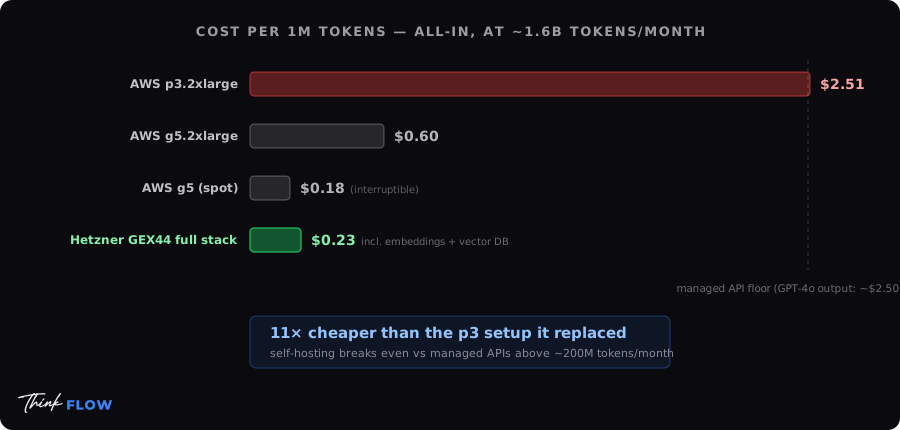
| AWS p3.2xlarge | $2,234 | 890M | $2.51 |
| AWS g5.2xlarge | $884 | 1.47B | $0.60 |
| AWS g5.2xlarge (spot) | $263 | 1.47B | $0.18 |
| Hetzner GEX44 | $272 | 1.63B | $0.17 |
| Hetzner GEX44 + CX43 + CX53 + LB | $377 | 1.63B | $0.23 (full stack) |
At production volume (~1.6B tokens/month), the full Hetzner stack costs $0.23 per 1M tokens all-in — including embeddings and vector search infrastructure. AWS p3 was $2.51 per 1M tokens, an 11× difference.
For context: OpenAI GPT-4o API pricing is ~$2.50–10.00 per 1M output tokens. Self-hosted inference on Hetzner brings marginal cost below $0.25 per 1M tokens — self-hosting breaks even against managed APIs above ~200M tokens/month.
Embedding service benchmark (CPU, CX43 vs c6i.xlarge)
| Metric | AWS c6i.xlarge | Hetzner CX43 |
|---|---|---|
| nomic-embed-text docs/sec | 48 | 52 |
| P95 batch latency (32 docs) | 680 ms | 610 ms |
| Monthly cost | $124 | $19 |
Embedding workloads are CPU-bound. Hetzner cloud VPS at post-June-2026 pricing still undercuts AWS by 85% with comparable performance.
Decision Framework for 2026
Cloud provider choice is not identity. Run the workload through this:
Are you serving user-facing inference with predictable traffic?
  YES → Hetzner GEX44/GEX131 (bare metal, flat pricing)
  NO  → Continue

Do you need multi-GPU training or FP16 70B+ without quantization?
  YES → AWS p4d/p5 (burst) or CoreWeave/Lambda (cheaper GPU cloud)
  NO  → Continue

Is your workload interruption-tolerant (batch, offline, internal tools)?
  YES → AWS g5 spot instances (approaches Hetzner pricing)
  NO  → Continue

Do you need sub-50ms latency for US East users?
  YES → AWS us-east-1 or a US provider — Hetzner adds 80–120ms transatlantic
  NO  → Continue

Do you require HIPAA BAA, FedRAMP, or SOC 2 with AWS-native audit?
  YES → AWS (or GCP/Azure with equivalent compliance)
  NO  → Continue

Is your monthly inference spend over $500 on AWS GPU instances?
  YES → Migration ROI exceeds 2 weeks of engineering time — do it
  NO  → Stay on AWS spot or managed API until volume justifies ops overhead

Are you running steady-state inference above 200M tokens/month?
  YES → Self-hosted Hetzner breaks even vs OpenAI/Anthropic API in month 1
  NO  → Managed API is cheaper when you factor in engineering time
When AWS still wins in 2026
- S3 — still nothing cheaper at scale for object storage. Keep it.
- SageMaker for experimentation — managed notebooks, experiment tracking, one-click deployment for data science teams without DevOps
- Multi-region active-active — AWS Global Accelerator + regional GPU pools for <100ms worldwide
- Burst training — spin up p4d for 48 hours, fine-tune, terminate. Paying $32.77/hr for 2 days beats owning hardware used twice a month
- Managed inference (Bedrock) — if your team has zero GPU ops capacity and volume is under 50M tokens/month
- Spot + auto-scaling for batch — nightly embedding jobs, document processing, eval runs
When Hetzner wins in 2026
- Steady-state inference — chatbots, RAG APIs, code completion, internal copilots
- European user base — Falkenstein/Nuremberg/Helsinki DCs with GDPR by default
- Cost-predictable scaling — flat monthly rate, no billing surprises from egress or NAT
- Single-GPU models up to 32B — GEX44 covers the sweet spot for most production deployments
- 70B inference with quantization — GEX131 at $1,397/month vs $23,922/month for p4d
For staging and CI GPU tests without committing to dedicated hardware, a DigitalOcean GPU Droplet on hourly billing fills the gap — spin up for integration tests, destroy after.
What We Kept on AWS
The migration was incremental, not ideological:
- S3 for model artifacts, training data, and user uploads
- SES for transactional email ($0.10/1K emails, managed deliverability)
- CloudFront for static marketing site assets (the Next.js apps moved to Hetzner + Cloudflare)
Hybrid cloud is not a compromise. It is engineering pragmatism — use each provider where its unit economics and operational model fit.
The Bottom Line
AWS GPU instances are priced for flexibility: spin up, scale out, tear down. That model is correct for training bursts and unpredictable workloads. It is wrong for inference that runs 24/7 at predictable volume.
In July 2026, a Hetzner GEX44 at €232/month delivers better inference performance than a p3.2xlarge at $2,234/month. The gap is not 10%. It is an order of magnitude. Add the supporting infrastructure — embeddings, vector DB, load balancer — and the full stack still costs $377/month vs $2,745 on AWS.
The migration is not free. It costs 3–4 weeks of engineering time, requires Docker/Terraform discipline, and demands a rollback plan. At $28K/year in savings, ROI pays back in under two weeks.
If the AWS GPU line item on the monthly bill looks familiar, we run this exact audit as a fixed-fee engagement: Cloud Cost & Migration Audit → — a line-item review of your bill, a benchmarked migration plan, and projected savings backed by real numbers, not a vendor slide. Prefer to just talk first? Contact us.
Affiliate Disclosure
Some links in this article are affiliate links. If you make a purchase through them, we may receive a commission at no extra cost to you. See our full disclosure.
Daniel Burcea
AI Systems Architect. Building private AI infrastructure since 2025.Read more →