Why 99% of AI Agencies Sell Chatbots — and Why They Are Losing
The real difference between API wrapping and private AI infrastructure. When a generic LLM is enough vs. when you need RAG and agent orchestration on dedicated hardware.
Why 99% of AI Agencies Sell Chatbots — and Why They Are Losing
Published by ThinkFlow · Reading time: ~10 min · For: CTOs, agency founders
If you have received at least one pitch in the past 12 months from an "AI agency" promising to transform your business with a chatbot, you are not alone.
Across Eastern Europe and beyond, hundreds of companies have slapped the word "AI" onto their brand, dropped a GPT widget onto a client website, and called it an "enterprise AI solution."
It is not fraud. It is worse. It is a fundamental misunderstanding of what AI looks like in production.
And you — as CTO, as founder, as technical lead — are paying the price: opaque recurring costs, vendor lock-in disguised as "integration," and a product that works flawlessly in the demo and collapses in the first week of real production.
What an AI Agency Is Actually Selling in 2026
Let us be blunt.
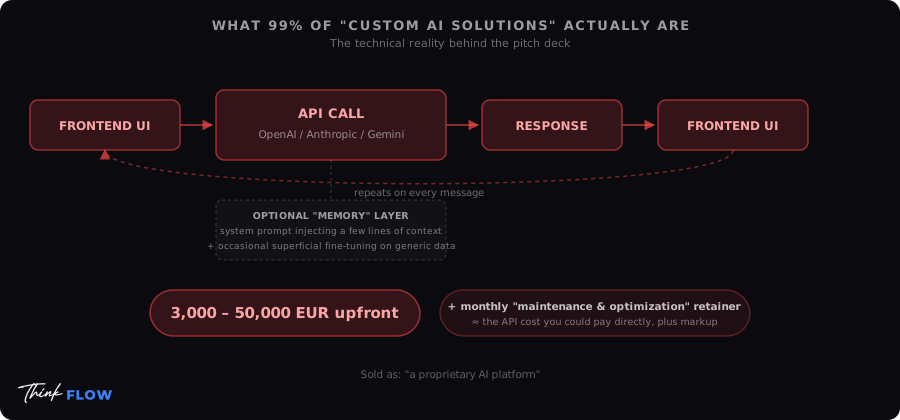
When an AI agency presents you with a "custom solution," what is technically happening in 99% of cases looks like this:
[Frontend UI] → [API call to OpenAI / Anthropic / Gemini] → [response] → [Frontend UI]
Sometimes there is a "memory" layer — a system prompt injecting a few lines of context. Occasionally there is superficial fine-tuning on generic data. The result: a branded chatbot, sold as a "proprietary AI platform."
The price? Anywhere from 3,000 EUR to 50,000 EUR upfront, plus a monthly "maintenance and optimization" retainer — which in practice covers the API cost you could pay directly, plus a healthy markup.
That is not AI infrastructure. It is reselling dressed up as consulting.
When a Generic LLM Is Enough — and You Should Not Overcomplicate Things
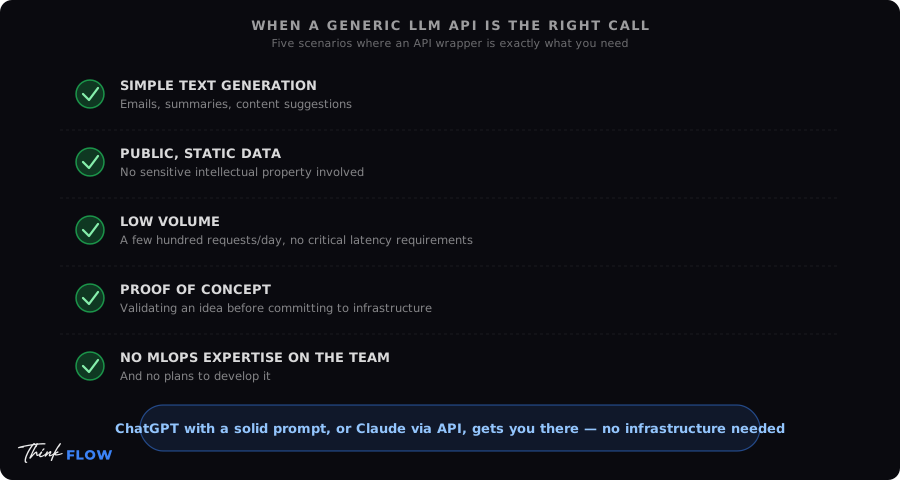
To be fair: there are scenarios where an API wrapper is exactly what you need.
A generic LLM works well when:
- You need simple text generation: emails, summaries, content suggestions
- Your data is public and static — no sensitive intellectual property involved
- Volume is low — a few hundred requests per day, no critical latency requirements
- Proof of concept — you are validating an idea before committing to infrastructure
- Your team lacks MLOps expertise and has no plans to develop it
In these cases, ChatGPT with a solid prompt or Claude via API will get you where you need to go. No infrastructure costs, no operational overhead, no dedicated engineers.
The agency that convinces you otherwise is selling air.
When You Need Something Different — and What "Different" Actually Means
The problem starts when your organization has needs that exceed what a generic model can responsibly deliver.
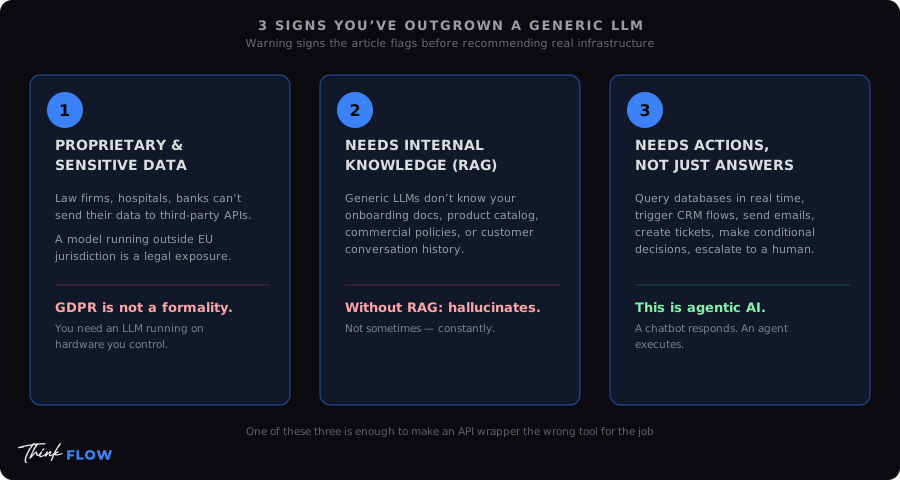
Warning signs you are already in that territory:
1. Your Data Is Proprietary and Sensitive
A law firm cannot send client contracts to OpenAI. A private hospital cannot process patient records through US-hosted public APIs. A financial institution cannot expose internal decision flows to a model running outside EU jurisdiction.
GDPR is not a formality. It is a concrete technical and legal reason why you need an LLM running on hardware you control.
2. You Need Answers Grounded in Your Internal Knowledge
Generic LLMs know what the internet knew in 2025. They do not know:
- Your internal onboarding procedures
- Your product catalog with technical specifications
- Your commercial policies and their exceptions
- Your customer conversation history
Without RAG (Retrieval-Augmented Generation) properly implemented, the model hallucinates. Not sometimes. Constantly. And in an enterprise context, a hallucination delivered to a client or employee costs far more than a 30,000 EUR chatbot.
3. You Need Actions, Not Just Answers
A chatbot responds. An agent executes.
The difference is not semantic. It is architectural. An agent orchestration system means the model can:
- Query databases in real time
- Trigger flows in your CRM
- Send emails, create tickets, update documents
- Make conditional decisions based on rules you define
- Escalate to a human operator when confidence is low
This is called agentic AI. And it does not get built with a ChatGPT widget.
RAG + Agent Orchestration on Dedicated Hardware — What It Actually Looks Like
If you have reached the point where you need real infrastructure, the architecture looks fundamentally different:
[Data sources: PDFs, DB, APIs]
        |
[Ingestion pipeline + chunking]
        |
[Embedding model — local: nomic-embed, e5-mistral]
        |
[Vector store: Qdrant / Weaviate — self-hosted]
        |
[Query → Retrieval → Re-ranking via CrossEncoder]
        |
[Local LLM: Llama 3.1, Mistral, Qwen — on dedicated GPU]
        |
[Agent orchestrator: LangGraph / custom]
        |
[Verifiable response + action]
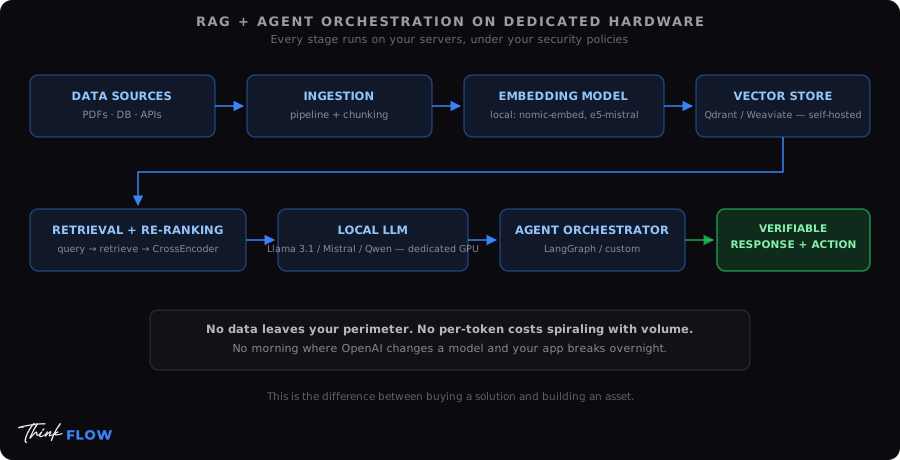
Every component in this stack runs on your servers, within your infrastructure, under your security policies.
No data leaves your perimeter. No per-token costs spiraling with volume. No morning where OpenAI changes a model and your application behavior changes overnight.
This is the difference between buying a solution and building an asset.
What the Numbers Actually Say
We benchmarked a self-hosted RAG pipeline on Ollama with Qwen2.5 32B against GPT-4 with naive RAG (top-k, no re-ranking) on a corpus of 500 Romanian legal documents — contracts, clauses, addenda. Results evaluated with RAGAS:
| Setup | Retrieval Accuracy | Hallucination Rate | Cost per 1,000 queries | |---|---|---|---| | GPT-4 + naive RAG | 78% | 14% | ~$4.20 | | Qwen2.5 32B local + CrossEncoder re-ranking | 94% | 3% | ~$0.11 |
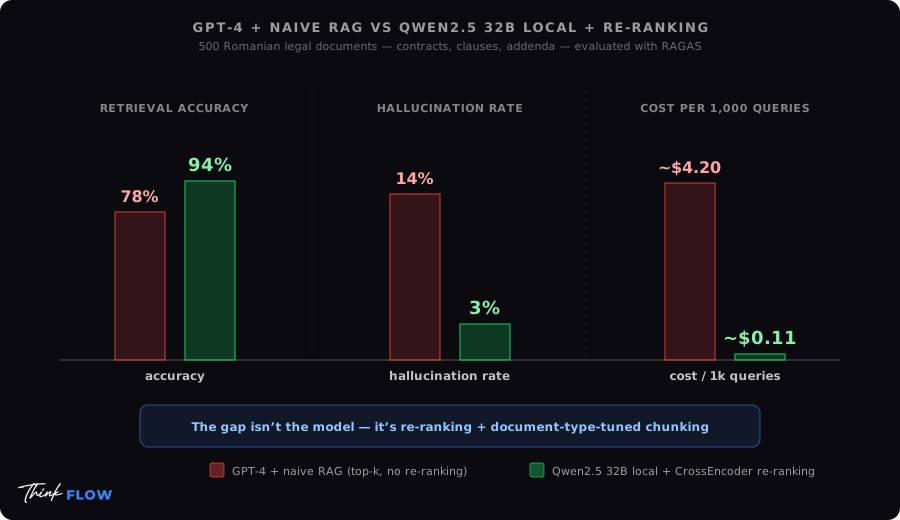
The accuracy gap does not come from the model. It comes from re-ranking and a chunking strategy tuned to the document type. GPT-4 is not bad — it is being applied incorrectly.
This is the kind of benchmark you should demand from any vendor, on your actual data, before signing anything.
Why Chatbot-Only Agencies Are Losing
The irony is that they are not losing because of clients. They are losing because of their own technical ceiling.
When an enterprise client starts asking the right questions — about data isolation, production latency, guaranteed SLAs, auditability of model decisions — the chatbot agency has no answers.
So they either:
- Lie — promise things they cannot deliver
- Lose the contract to a competitor with real MLOps competence
- Outsource everything they do not understand, obliterating their margin and quality control
The enterprise market is maturing fast. CTOs at major banks, retailers, and healthcare companies have already seen the first wave of chatbot failures. Now they are demanding real technical demonstrations, not slides about "the power of AI."
What a Proper Contract Looks Like vs. What You Actually Get
A serious Statement of Work for an enterprise AI solution includes:
- Latency SLA with specifics: "P95 under 2 seconds for queries up to 5,000 tokens" — not "generally performs well"
- Audit rights: your right to inspect the architecture, data access logs, and model behavior at any time, without notice
- Exit plan with no exit costs: your data, your vectors, your fine-tuned model — they belong to you and you can take them in a portable format
- Training data ownership clause: any fine-tuning or embeddings generated on your data cannot be reused by the vendor for other clients
- Defined rollback procedure: if a model update degrades performance, reversion to the previous version happens within 4 hours
What you typically get: a 3-page PDF stating "we commit to providing quality services" and a termination clause requiring 3 months notice plus 6 months of prepaid fees.
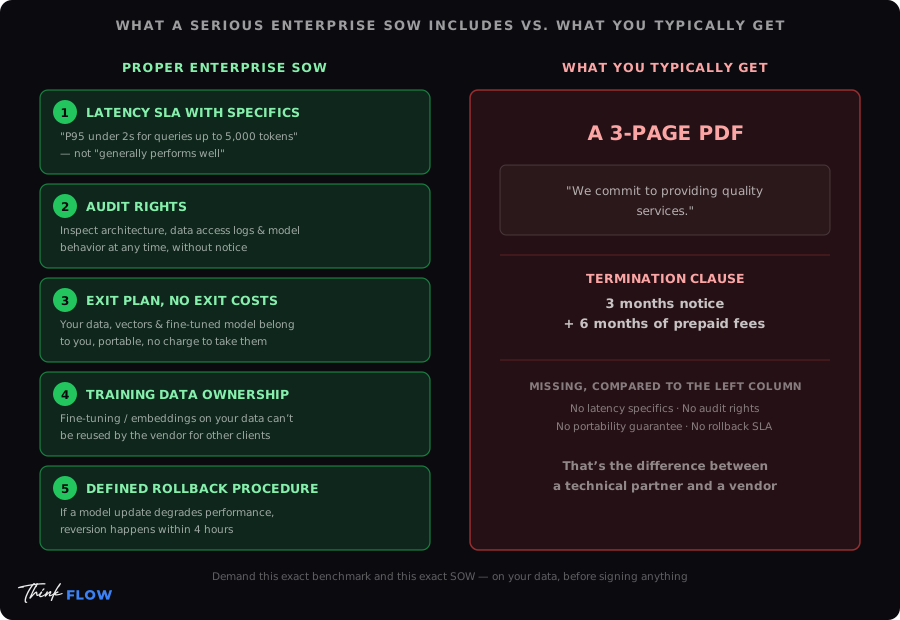
That is the difference between a technical partner and a vendor.
What to Ask Before You Sign Anything
Before any contract with an AI agency, ask these questions:
- "Where does the model physically run?" — If the answer is "OpenAI's cloud," you know what you are dealing with.
- "How do you isolate our data from other clients?" — Multi-tenancy without isolation is a real risk.
- "Walk me through your RAG pipeline." — If they do not know what re-ranking is, the conversation is over.
- "What happens if OpenAI changes the model or API?" — No clear answer means total third-party dependency.
- "Can we conduct a technical audit of the architecture?" — Any serious vendor accepts this immediately.
The answers will tell you everything you need to know.
The Bottom Line: AI Is Not a Product. It Is Infrastructure.
Chatbots are not inherently bad. They are just insufficient for complex problems.
The difference between an agency selling a widget and a real technical partner is not about branding. It is about architecture, accountability, and operational competence.
If your organization handles sensitive data, needs precise and grounded responses, or wants to automate processes with real consequences — you need a system built correctly, not an API with a pretty prompt in front of it.
At ThinkFlow, we build exactly that: private AI infrastructure, with properly implemented RAG and agent orchestration on dedicated hardware — for organizations that cannot afford to experiment.
If you want a technical assessment of your current setup or a live demonstration with your actual data, let's talk
ThinkFlow · Bucharest, Romania · thinkflow.ro
Affiliate Disclosure
Some links in this article are affiliate links. If you make a purchase through them, we may receive a commission at no extra cost to you. See our full disclosure.
Daniel Burcea
AI Systems Architect. Building private AI infrastructure since 2025.Read more →