Best Vector Database for RAG in 2026: Top 5 Solutions Compared | The Definitive Infrastructure Guide for AI Developers
Definitive comparison of Pinecone, Weaviate, Qdrant, Chroma, and Milvus for RAG — benchmarks, pricing, semantic caching, and verdict by team size.
Best Vector Database for RAG in 2026: Top 5 Solutions Compared | The Definitive Infrastructure Guide for AI Developers
TL;DR: For RAG applications in 2026, the best vector database balances native hybrid search, semantic caching capabilities, and predictable scaling economics. Pinecone leads for enterprise teams requiring fully managed reliability with zero operational overhead and native sparse-dense retrieval. Weaviate is the top choice for data-centric organizations needing modular architecture and strong schema support alongside cloud flexibility. Qdrant delivers exceptional performance and low latency for high-concurrency workloads via its Rust-based engine, making it ideal for scaling startups. For budget-conscious teams prioritizing developer experience and open-source transparency, Chroma offers rapid deployment with growing enterprise features, while Milvus (Zilliz) remains the scalability king for billion-scale embeddings in complex distributed environments. Evaluate based on metadata filtering depth, true cost-per-query models, and semantic caching impact on token reduction.
1. What is a Vector Database for RAG?
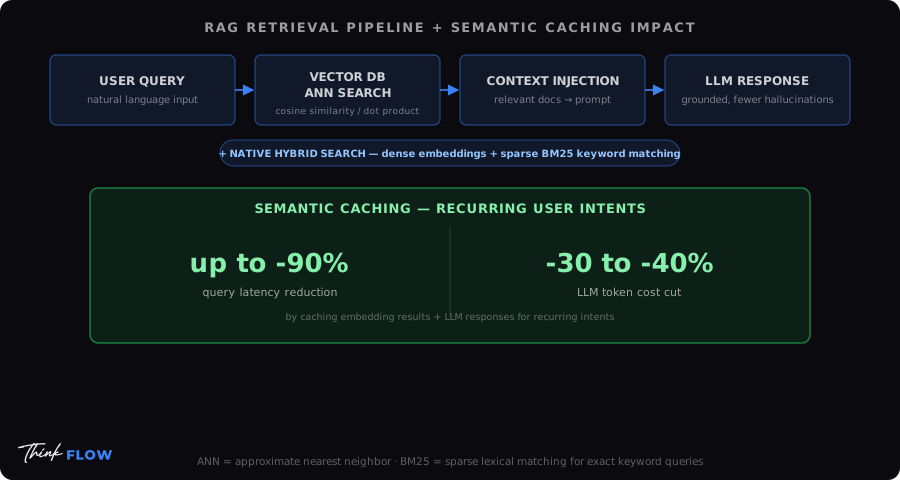
A vector database serves as the high-performance memory layer for Retrieval-Augmented Generation (RAG) pipelines, enabling AI applications to store, index, and retrieve unstructured data represented as mathematical embeddings. Unlike traditional relational databases that rely on keyword matching, vector databases utilize approximate nearest neighbor (ANN) algorithms to find semantically similar vectors based on cosine similarity or dot product distances. In the context of RAG, this retrieval process feeds relevant context documents to Large Language Models (LLMs), grounding responses and significantly reducing hallucinations.
As of 2026, the architecture of vector databases has evolved beyond simple semantic search. Modern solutions now deeply integrate hybrid search technologies that combine dense vector embeddings with sparse lexical matching (BM25) to handle exact keyword queries alongside conceptual retrieval. Furthermore, leading vendors have introduced native support for semantic caching, allowing applications to cache embedding results and LLM responses for recurring user intents, reducing latency by up to 90% and cutting token costs by 30-40%. With the rise of multi-modal RAG systems processing text, images, and audio simultaneously, vector databases must now handle heterogeneous vectors, advanced metadata filtering at scale, and deterministic performance guarantees essential for production-grade AI products.
Choosing the right infrastructure requires evaluating technical capabilities against business constraints. Key decision factors include throughput vs. latency benchmarks, SDK compatibility with frameworks like LangChain and LlamaIndex, data sovereignty requirements, and billing models that align with usage patterns. A misalignment in these areas can lead to unpredictable cloud cost spikes, vendor lock-in risks, or suboptimal retrieval accuracy that degrades user experience.
2. Pinecone (Managed Cloud)
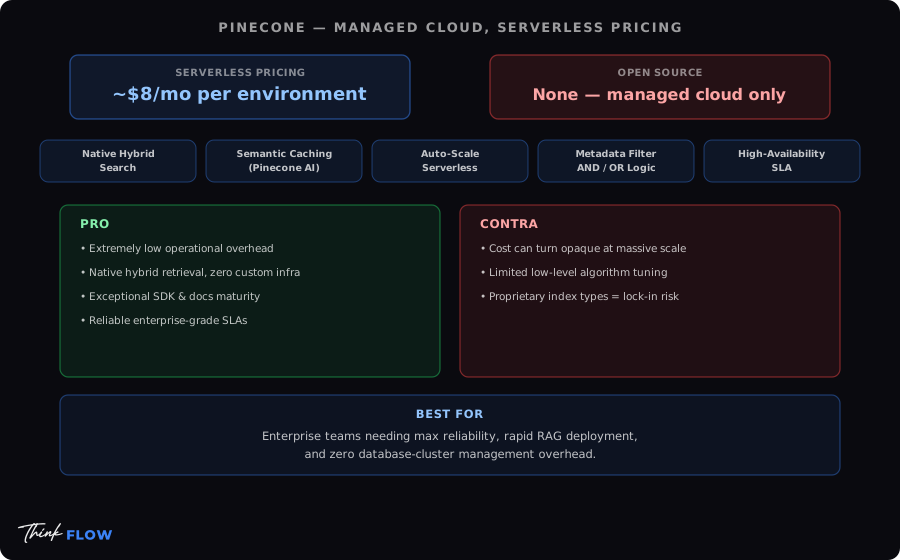
Pinecone remains the industry standard for organizations seeking a fully managed vector database that abstracts away infrastructure complexity while delivering robust RAG capabilities. In 2026, Pinecone's native hybrid search architecture, powered by sparse-dense retrieval combined with contextually aware embeddings, provides superior relevance compared to pure vector approaches. Its serverless index model scales automatically, making it the go-to for enterprises and well-funded startups prioritizing speed-to-market over infrastructure control.
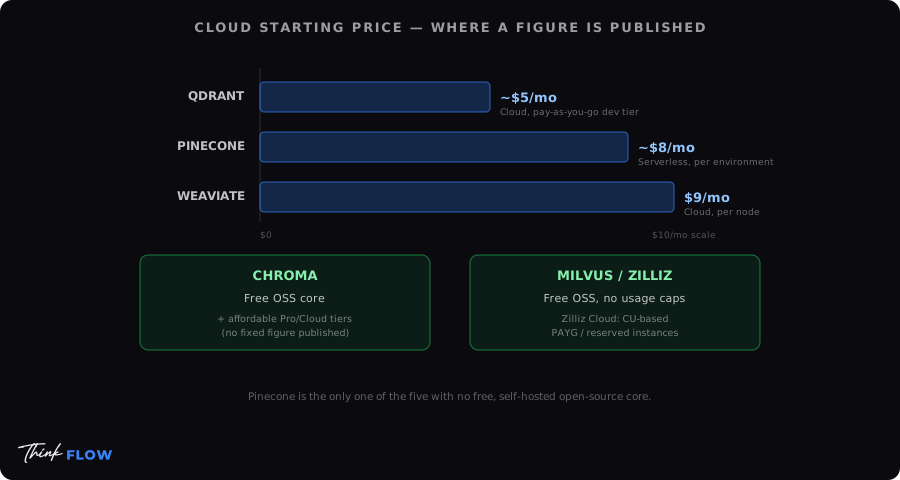
- Price: Serverless pricing starts at approximately $8/month per environment (billing by units consumed). Enterprise plans involve compute units with predictable commitments but can scale significantly based on volume. Managed service fees apply.
- Characteristics key: Native hybrid search, Semantic caching via Pinecone AI features, contextually aware embeddings for improved ranking, auto-scale serverless architecture, robust metadata filtering (AND/OR logic), high available SLA.
- Pro: Extremely low operational overhead; native support for hybrid retrieval without custom infrastructure integration; exceptional SDK maturity and documentation; reliable SLAs suitable for mission-critical enterprise apps.
- Contra: Cost structure can become opaque at massive scale; limited customization under the hood prevents tuning specific algorithmic parameters; potential vendor lock-in due to proprietary index types.
- Cel mai bun pentru: Enterprise teams requiring maximum reliability, rapid RAG deployment, and seamless integration with commercial LLM providers without managing database clusters.
Explore Pinecone for your RAG infrastructure
3. Weaviate (Open Core & Cloud)
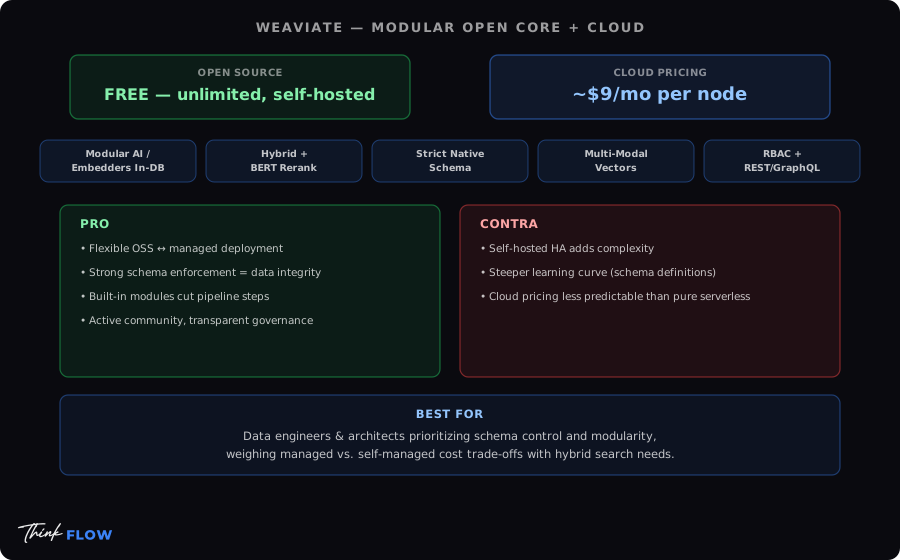
Weaviate offers a unique modular architecture that empowers developers to define strict data schemas, integrating native AI modules for embedding generation directly within the database layer. This "data-centric" approach is particularly advantageous in 2026 where complex enterprise RAG pipelines require structured metadata management alongside unstructured vector storage. Weaviate supports both open-source self-hosting and a managed cloud offering, providing flexibility for organizations concerned with data sovereignty and cost control.
- Price: Open-source version is free for unlimited scalability on-premise or self-managed. Cloud hosting starts around $9/month per node/serverless tier pricing model depending on compute and storage requirements.
- Characteristics cheie: Modular architecture (AI embedders run inside the DB), strict native schema support, hybrid search with BERT-based reranking integration, multi-modal vector support, role-based access control, extensive REST/GraphQL APIs.
- Pro: Unmatched flexibility between open-source and managed deployments; strong schema enforcement ensures data integrity; built-in modules reduce pipeline bottlenecks; active community and transparent governance.
- Contra: Complexity can increase when self-hosting for high availability comparisons with managed peers; learning curve slightly steeper due to schema definitions; cloud pricing may be less predictable than pure serverless competitors.
- Cel mai bun pentru: Data engineers and architects prioritizing schema control, modularity, and those evaluating managed vs. self-managed vector database cost trade-offs while needing hybrid search capabilities.
Get started with Weaviate Cloud or Open Source
4. Qdrant (High-Performance Rust Engine)
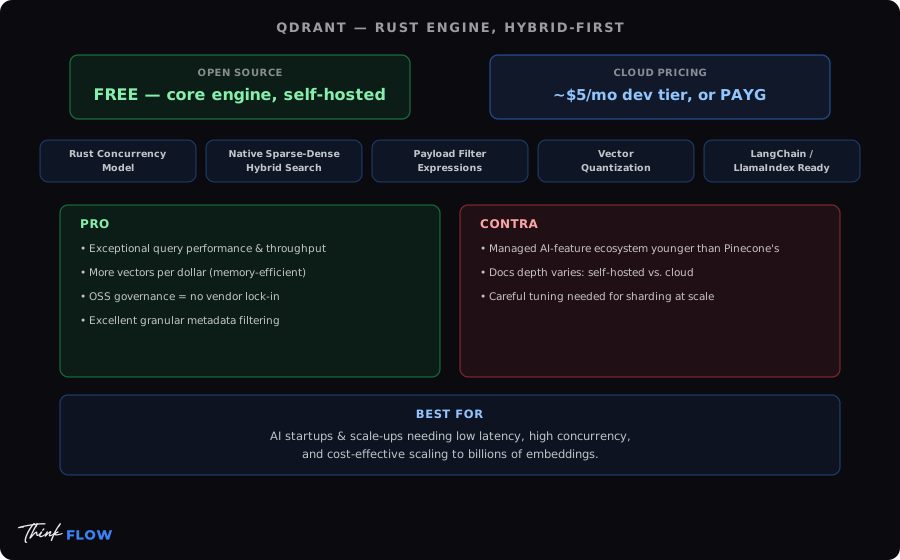
Qdrant distinguishes itself through its high-performance Rust-based engine, optimized for low-latency queries and high-concurrency workloads. Built with a hybrid search-first philosophy, Qdrant natively supports sparse vectors alongside dense embeddings, enabling keyword-driven retrieval without separate indexing pipelines. Its payload filtering system is highly efficient, allowing complex conditional queries on metadata even at massive scales, which is critical for hierarchical RAG systems requiring precise context routing.
- Price: Open-source core is free; Cloud pricing based on compute resources and query throughput, generally optimized for cost-efficiency at scale with flexible tiers starting around $5/month for development or pay-as-you-go enterprise clouds.
- Caracteristici cheie: Rust-based concurrency model, native sparse-dense hybrid search, advanced payload filtering via expressions, semantic caching integrations (via third-party modules), vector quantization support for storage efficiency, strong LlamaIndex/LangChain compatibility.
- Prov: Exceptional query performance and throughput; efficient memory usage allows more vectors per dollar; open-source governance ensures no vendor lock-in; excellent metadata filtering capabilities for granular RAG retrieval.
- Contra: Managed ecosystem slightly younger than Pinecone's regarding built-in AI features like semantic caching; documentation depth varies between self-hosted vs. cloud environments; requires careful tuning for distributed sharding in massive deployments.
- Cel mai bun pentru: AI startups and scale-ups requiring low-latency performance, high-concurrency handling, and cost-effective scaling to billions of embeddings with strong open-source foundations.
Deploy Qdrant on Cloud or Open Source
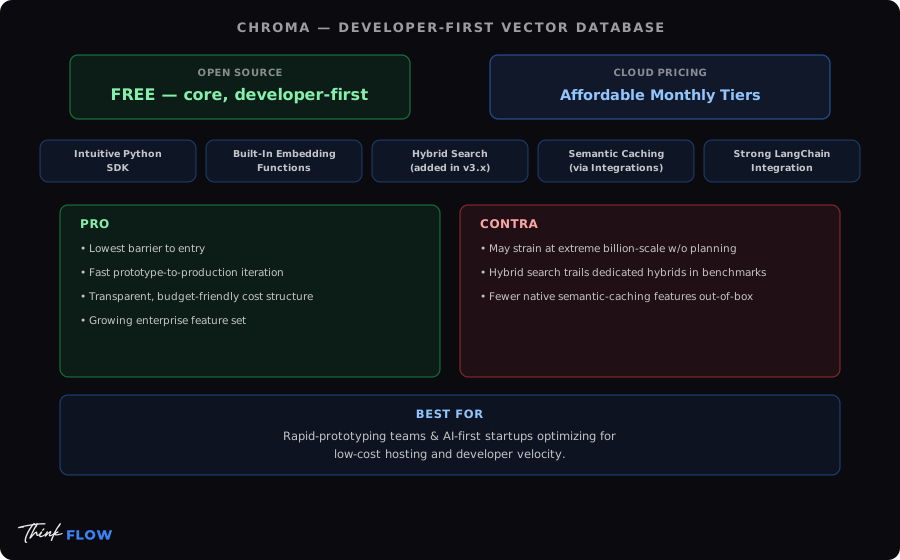
5. Chroma (Developer-First Vector Database)
Chroma has emerged as the preferred choice for developers prioritizing developer experience (DX) and rapid prototyping, now maturing into a viable production tool for mid-scale applications in 2026. Known initially for its simplicity, Chroma now offers hybrid search capabilities, embedding functions built directly into the client library, and enterprise-grade deployments via managed service tiers. It integrates natively with almost every major AI framework, making it an ideal entry point for teams building RAG pipelines where cost agility and ease of use are paramount.
- Price: Open-source core is free; Pro/Cloud versions offer team collaboration features, advanced security, and managed hosting starting at affordable monthly rates, positioning it as a low-cost vector database option for LLM startups scaling costs carefully.
- Caracteristici cheie: Intuitive Python SDK, built-in embedding functions, hybrid search support, semantic caching via integrations, simple migration paths, strong LangChain integration, collaborative workspace features in cloud version.
- Pro: Lowest barrier to entry; incredibly fast iteration cycles for prototype-to-production workflows; transparent cost structure making it excellent for budget-conscious scaling; growing enterprise feature set reduces migration anxiety.
- Contra: May face limitations at extreme billion-scale embeddings without careful architectural planning compared to specialized distributed engines; hybrid search performance can trail dedicated hybrids in highly competitive benchmark scenarios; fewer advanced semantic caching native capabilities out-of-the-box.
- Cel mai bun pentru: Rapid prototyping teams, AI-first startups optimizing for low-cost hosting and developer velocity, and applications scaling moderately where ease of integration outweighs extreme throughput demands.
6. Milvus / Zilliz (Billion-Scale Distributed Architecture)
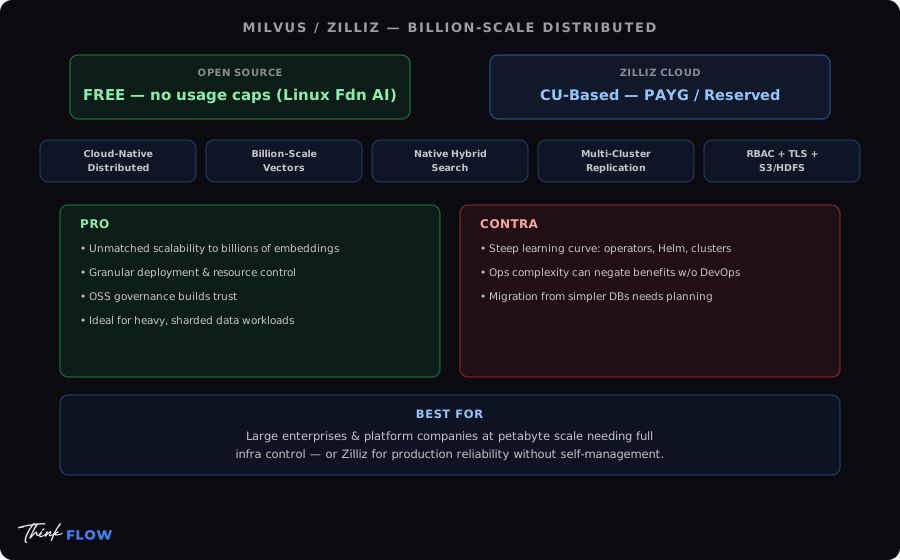
For organizations requiring massive scalability and strict data governance, Milvus (the open-source project under Linux Foundation AI) and its managed counterpart Zilliz provide a distributed vector database architecture capable of handling billions of vectors with linear scaling. Milvus is designed for complex, multi-tenant environments where high availability and flexible deployment topologies are non-negotiable. It supports hybrid search, dynamic schemas that evolved from strict models in 2024/2025 updates, and extensive plugin ecosystems including semantic caching modules via integrations like Semantic Kernel or custom deployments.
- Price: Open-source Milvus is completely free with no usage caps; Zilliz Cloud Managed Service offers pay-as-you-go or reserved instance pricing based on CUs (Compute Units), providing enterprise SLAs and managed operations starting around flexible tiers for pilot projects but higher commitment costs at scale.
- Caracteristici cheie: Cloud-native distributed architecture, billion-scale vector handling, hybrid search capabilities, multi-cluster replication, robust security features (RBAC, HTTPS/TLS), highly configurable storage backends (S3/HDFS), comprehensive plugin system.
- Prov: Unmatched scalability to billions of embeddings; granular control over deployment and resource allocation; open-source governance fosters trust and transparency; ideal for heavy data workloads requiring distinct sharding strategies.
- Contra: Steeper learning curve regarding operators, Helm charts, or cluster configuration if self-hosting; operational complexity can negate benefits compared to managed-only providers unless dedicated DevOps is available; migration from simpler DBs requires architectural planning.
- Cel mai bun pentru: Large enterprises and platform companies managing petabyte-scale data volumes, requiring absolute control over infrastructure, or utilizing Zilliz for production-grade reliability without the burden of self-management.
Explore Milvus Open Source or Zilliz Cloud
7. Tabel Comparativ
| Caracteristica | Pinecone | Weaviate | Qdrant | Chroma | Milvus / Zilliz | |---|---|---|---|---|---| | De start Pret | ~$8/mo (Serverless) | $9/mo (Cloud Node) or Free OSS | ~$5/mo (Cloud Pay-as-you-go) or Free OSS | Free OSS / Affordable Cloud Tiers | Free OSS / Zilliz CUs based | | Search Hibrida | Native Sparse-Dense | Native Hybrid + BERT Reranking Module | Native Sparse Vectors | Added in v3.x via integration | Native Hybrid Support | | Semantic Caching | Native AI Features | Via Integrations/Modules | Via Integrations/Extensions | Via Framework Level/Clients | Via Plugins/Integrations | | Filtrare Metadata | Strong (AND/OR) | Very Strong (Schema-based) | Excellent (Expression queries) | Solid for mid-scale | Enterprise Grade (Complex) | | Trial Gratuit | Yes (Serverless Free Tier) | Yes (Cloud Sandbox / OSS) | Yes (Open Source License) | Yes (Local/Cloud Trial) | Yes (OSS / Zilliz Free Tier) | | Integrari | LangChain, LlamaIndex, Direct SDKs | Extensive Modules, REST/GraphQL, All Major SDKs | LangChain, LlamaIndex, Direct Rust/Py/Go SDKs | Native Deep Integration with Major AI Frameworks | Broad Ecosystem, Custom Plugins, TF Serving |
8. Verdict per Use Case
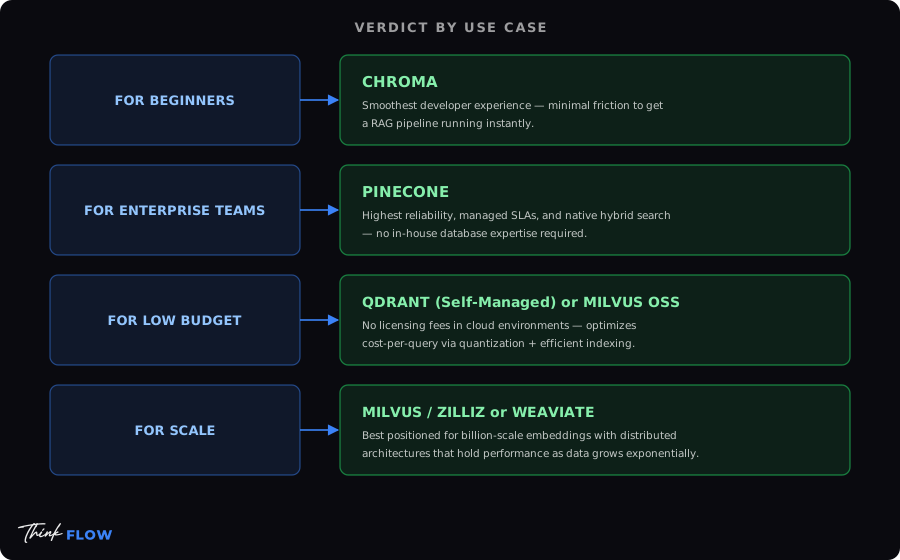
| Scenariu | Recomandare | |---|---| | Pentru incepatori | Chroma: Offers the smoothest developer experience with minimal friction to get a RAG pipeline running instantly. | | Pentru echipe enterprise | Pinecone: Provides the highest reliability, managed SLAs, and native hybrid search without requiring internal database expertise. | | Pentru buget redus | Qdrant (Self-Managed) or Milvus OSS: Allows hosting with no licensing fees in cloud environments, optimizing cost-per-query through quantization and efficient indexing. | | Pentru scalare | Milvus/Zilliz or Weaviate: Best positioned to handle billion-scale embeddings with distributed architectures that maintain performance as data volumes grow exponentially. |
9. Intrebari Frecvente (FAQ)
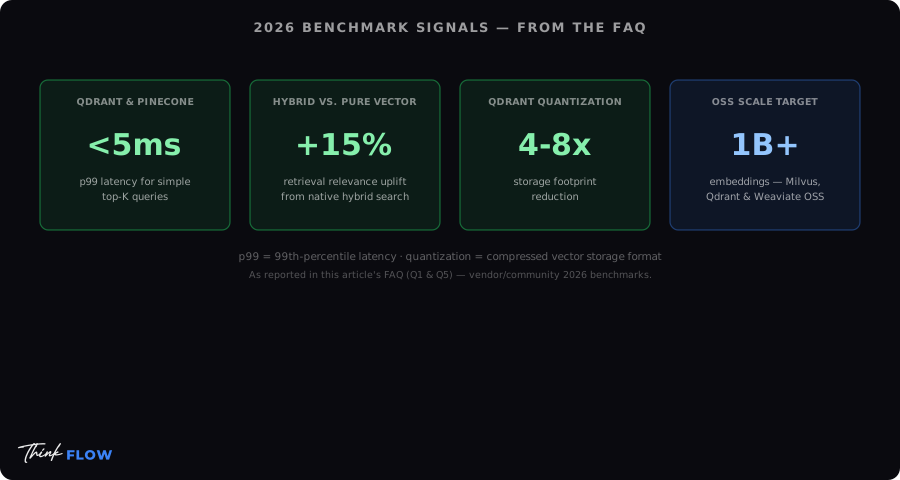
Q1: Cum se compara benchmark-urile de latența pentru vector database în RAG in 2026? A: În 2026, benchmark-urile se axează pe latența p99 și nu doar media, deoarece aplicațiile RAG sensibile la timp necesită răspunsuri consistente. Qdrant și Pinecone domină adesea la scăderea latenței sub 5ms pentru interogări simple de top-K, datorit optimizării engine-ului și cache-lui. Benchmark-urile recente arată că bazele de date cu suport nativ hybrid pot îmbunătăți relevanța recuperării cu până la 15% față de vectorii drepți, reducând totodată latența cauzată de pasul de reranking suplimentar care era obligatoriu în anii precedenți.
Q2: Cum evaluăm bazele de date vectoriale pentru pipeline-uri enterprise RAG? A: Evaluarea trebuie să includă: 1) Capacitatea de filtrare metadata complexă (esential pentru securitatea datelor și multi-tenancy). 2) SLA declarate și garantiate de vendor. 3) Compatibilitatea cu arhitecturile hibride actuale. 4) Riscul de vendor lock-in prin existența opțiunilor open-source sau portabilitatea formatăților. De asemenea, verificarea suportului native pentru semantic caching este crucială pentru a gestiona costul tokenilor LLM în producție.
Q3: Care este comparatia costurilor între vector database managed vs self-managed in 2026? A: Managed servisiile elimină opex-ul devOps și hardware managementului, dar pot deveni scum la volume mari din cauza facturacionii pe bază de unitati sau query-uri. Self-managed open-source (Qdrant, Milvus, Weaviate) permite control total al resurselor cloud, ideal pentru startup-uri care doresc sa scape de vendor pricing spikes. Cu toateas, self-managed aduce costuri ascunse in operațiuni și monitoring. Pentru 1B+ embeddings, milvus managed (Zilliz) poate ofori un echilibru între cost predictabil si fara burden operational comparativ cu alte managed players.
Q4: Există ghiduri de integrare intre Pinecone, Qdrant si Weaviate pentru RAG? A: Toate cele trei sunt primele clas la integrarea cu LangChain și LlamaIndex, cu SDK-uri native robuste. Documentatiile oficiale oferă tutoriale pas-cu-pas. Pinecone se integreaza foarte fluid prin callback-uri de context-aware embedding. Weaviate permite embedder-e locale in cluster, reducând latency-ul pentru generatoria embeddings. Qdrant pun la dispozitie function-level integrări si suport native pentru payload filtering complex care este util în RAG avansat cu routing conditioanal. Comparatiile technique arată că migratia intre ele este fezabilă deoarece formatele vectoriale sunt standardizate; totuși, specificațiile client trebuie refactorizate.
Q5: Care sunt alternativele open-source pentru vector search care scalaza spre 1B embedding-uri in 2026? A: Mainii contenderi sunt Milvus, Qdrant și Weaviate. Milvus rămâne liderul de facto pentru arhitecturi distribuite masive, susținute de Linux Foundation AI, ofrind sharding automat si multi-cluster replikare. Qdrat excela la performanța per-query cu quantizare aggresivă care reduce footprint-ul de stocare prin factori 4-8x. Weaviate oferă modularitate care permite adaugarea procesări ai interne clusterele, optimizând throughput-ul. Pentru startup-uri, Milvus și Qdrat offură cele mai fine modele gratuite pe OSS, permițànd scalarea la cost zero până când volumul justifică migrarea catre managed Zilliz sau cloud dedicat.
Continut generat cu asistenta AI si revizuit de Daniel Burcea. Linkurile contin linkuri afiliate. Daca achizitionezi prin ele, primim un comision la cost zero pentru tine.
Affiliate Disclosure
Some links in this article are affiliate links. If you make a purchase through them, we may receive a commission at no extra cost to you. See our full disclosure.
Daniel Burcea
AI Systems Architect. Building private AI infrastructure since 2025.Read more →