How to Charge for an MCP Tool: A Working x402 Endpoint in Under an Hour
MCP servers are free by default. Here is the wire-level mechanics of putting a price on one — the real 402 demand, the real rejection when payment fails, the real on-chain settlement when it succeeds, and what breaks.

Most Model Context Protocol servers are free. Not free as in open source — free as in nobody ever wired a payment to them. You expose a tool, an agent calls it, you eat the compute.
That is fine for a hobby server. It stops being fine the moment your tool does something expensive: a scrape that burns proxy bandwidth, a model call you pay for, a dataset you licensed. At that point you need the caller to pay per invocation, and the caller is not a human with a credit card — it is an agent, at 3am, with no browser and no checkout flow.
x402 is the mechanism for that. It revives HTTP status code 402 Payment Required — reserved in the original spec and unused for thirty years — and gives it a concrete meaning: here is what this costs, here is where to send it, retry with proof.
Everything below comes from a real endpoint: a FastAPI server wrapped in the official
x402 Python package (v2.16.0), running against its default public facilitator
(x402.org/facilitator) on Base Sepolia testnet. Full runnable code is linked at the end.
Two round trips, three captures
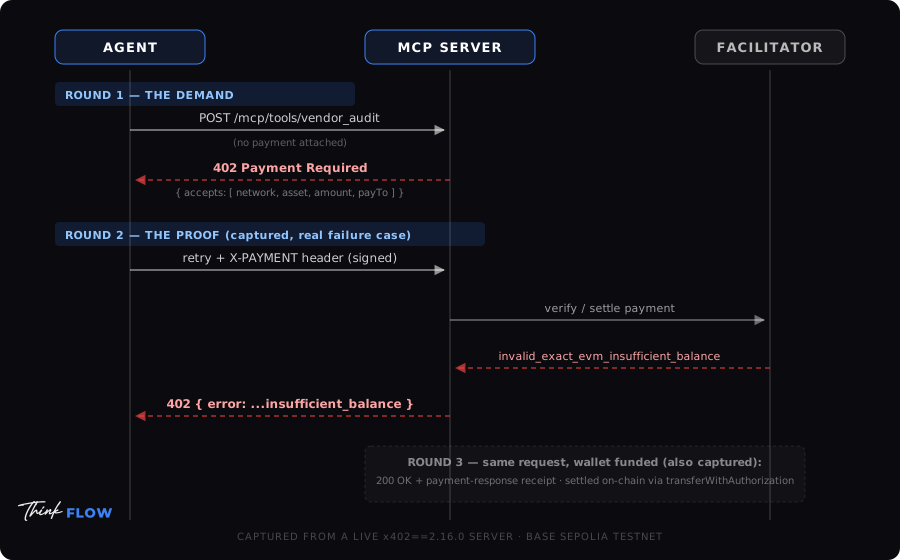
An agent calls your paid tool. It has no idea it costs money.
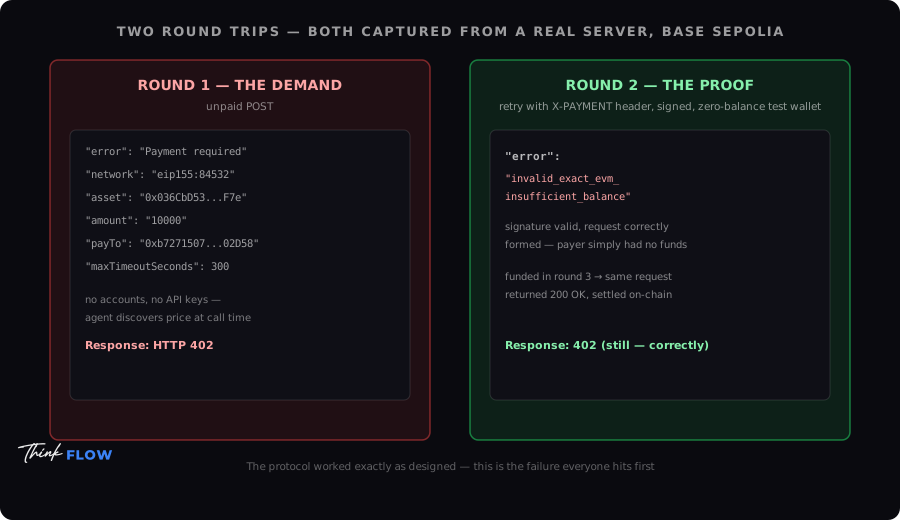
Round 1 — the demand. An unpaid POST gets a 402 back. This is the actual body my
demo server returned — not simplified, not retyped:
{
  "x402Version": 2,
  "error": "Payment required",
  "resource": {
    "url": "https://api.example.com/mcp/tools/vendor_audit",
    "description": "Inspect an MCP server URL or repo; return monetization recommendations",
    "mimeType": ""
  },
  "accepts": [
    {
      "scheme": "exact",
      "network": "eip155:84532",
      "asset": "0x036CbD53842c5426634e7929541eC2318f3dCF7e",
      "amount": "10000",
      "payTo": "0xb7271507cFa220cC825568Cfb263C3dEa9f02D58",
      "maxTimeoutSeconds": 300,
      "extra": { "name": "USDC", "version": "2" }
    }
  ]
}
Four fields decide whether an agent can actually pay you. network is a
CAIP-2 identifier — eip155:84532 is Base Sepolia
testnet, eip155:8453 would be Base mainnet. Mixing the two up is the single most common way
to make a working integration look broken: the request is valid, the signature checks out,
and the payment still fails because the client signed for a chain the server isn't watching.
asset is the token contract address, chain-specific — the one above is Sepolia-testnet USDC,
not the mainnet contract. amount is denominated in the token's smallest unit, so 10000 at
6 decimals is $0.01, not ten thousand dollars. This one fails silently too: the request
looks valid and the amount is simply wrong by six orders of magnitude in either direction.
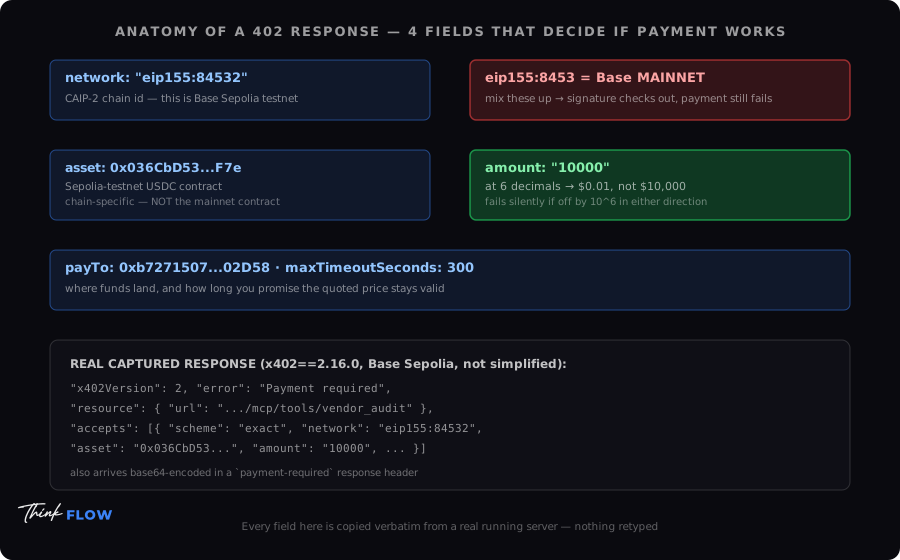
Note this is the raw JSON — on the wire, the same payload also arrives base64-encoded in a
payment-required response header, which is what a client actually reads.
Round 2 — the proof. The agent builds a payment payload, signs it, and retries with an
X-PAYMENT header carrying the signature. Here is what came back when I did that for real,
using a freshly generated account with zero balance on Base Sepolia:
{
  "x402Version": 2,
  "error": "invalid_exact_evm_insufficient_balance",
  "resource": { "url": "https://api.example.com/mcp/tools/vendor_audit", "...": "..." },
  "accepts": [ { "...": "same payment requirements as round 1" } ]
}
That string is the facilitator's real error code. The signature was valid, the request was correctly formed — the protocol worked exactly as designed, and the payer simply didn't have the money.
Round 3 — funded, settled for real. I funded a payer account from
Circle's public faucet and ran the same request against the same
server code. This time it comes back 200:
{
  "url": "https://example.com/mcp",
  "recommendation": "expose as a priced x402 tool at $0.01/call",
  "paid": true
}
with a payment-response header that decodes to:
{
  "success": true,
  "payer": "0x3214cB6C1936F1430a5236E6f062C7c17cC9E0E9",
  "transaction": "0x9530b6634adabf59dd8234e993d2bb9cba1c30703f359f9b1d5d9fc42108dd86",
  "network": "eip155:84532"
}
That transaction hash is not a claim you have to take on faith —
check it yourself on Base Sepolia Blockscout:
status ok, sent to the real USDC contract, method transferWithAuthorization — the exact
EIP-3009 gasless-authorization pattern the client signed. Nothing changed in the server code
between the rejection and the settlement; the payer simply had funds the second time.
One thing to expect if you do open that link: the receiving address on-chain is not the
payTo shown in the round 1 capture above. The demo mints throwaway keys on every run
(gen_wallets.py), so the funded run had a fresh receiving address. Same code, different
disposable wallets — which is also why publishing these captures costs nothing.
That is the whole protocol. No accounts, no API keys to provision, no invoice. The agent discovers the price at call time and settles in the same exchange.
Why this shape and not an API key
The obvious alternative is what every SaaS does: sign up, get a key, bill monthly. That works when a human signs up. It falls apart for agent traffic for three reasons.
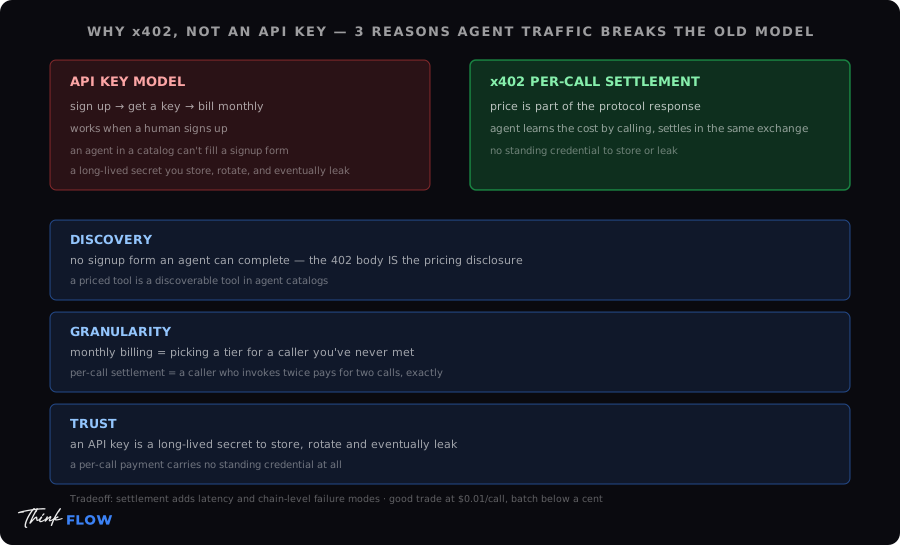
Discovery. An agent that finds your tool in a catalog cannot complete a signup form. With x402 the price is part of the protocol response — the agent learns the cost by calling.
Granularity. Monthly billing means you pick a tier for a caller you have never met. Per-call settlement means a caller who invokes you twice pays for two calls.
Trust. An API key is a long-lived secret you have to store, rotate, and eventually leak. A per-call payment carries no standing credential at all.
The tradeoff is real: settlement adds latency, and you inherit chain-level failure modes an API key never had — see the insufficient-balance response above, which is exactly that kind of failure. For a tool that costs a cent per call this is a good trade. For a tool that costs a hundredth of a cent, the settlement overhead dominates and you should batch instead.
Making the tool discoverable
An endpoint nobody can find is not a business. Catalog metadata is what turns your 402 into revenue, and it is the part most people skip.
{
  "name": "mcp-server-audit",
  "description": "Inspect an MCP server URL or repo; return monetization recommendations",
  "endpoint": "https://api.example.com/mcp/tools/vendor_audit",
  "pricing": { "amount": "10000", "asset": "USDC", "network": "eip155:8453" },
  "input_schema": { "type": "object", "properties": { "url": { "type": "string" } }, "required": ["url"] }
}
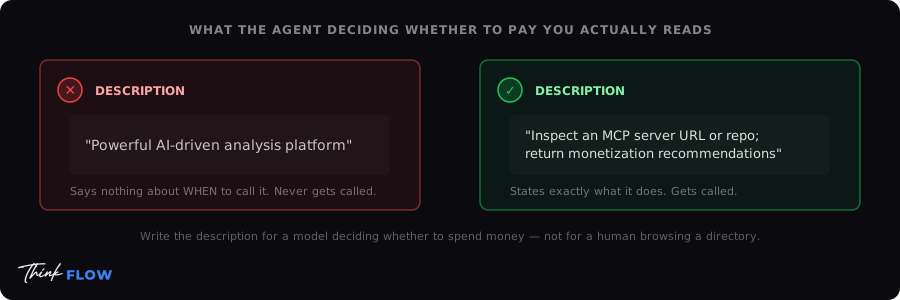
Write the description for a model, not for a human browsing a directory. The agent deciding
whether to spend money on you reads exactly this string. "Inspect an MCP server and return
monetization recommendations" gets called. "Powerful AI-driven analysis platform" does not —
it says nothing about when to call it.
The same rule applies to the tool's own MCP description. Prescriptive descriptions that state the trigger condition ("call this when the user asks about current prices") measurably outperform ones that only describe capability.
What breaks
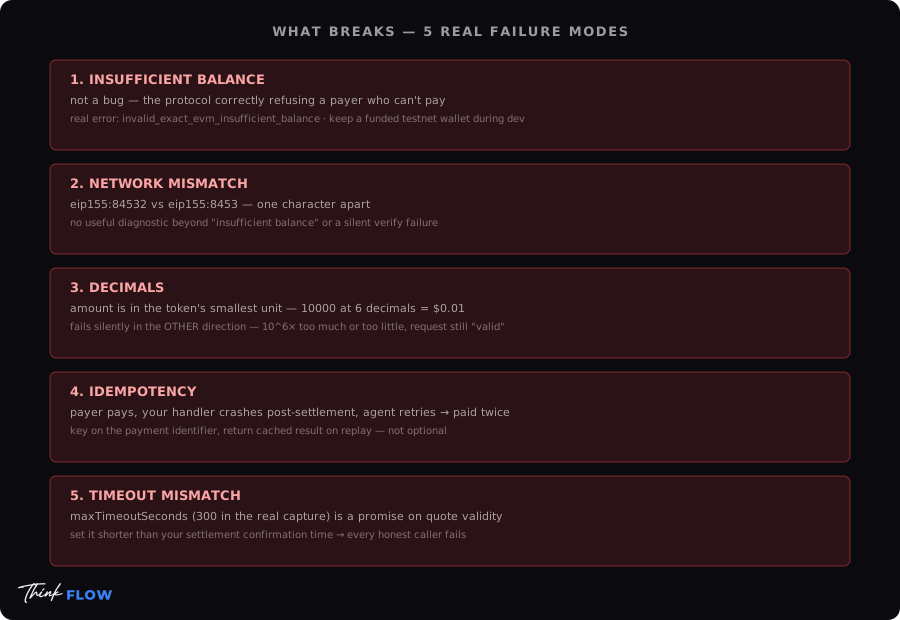
Insufficient balance — shown above, and the one you will hit constantly in development unless you keep a funded testnet wallet on hand. It is not a bug; it is the protocol correctly refusing to serve someone who can't pay. Budget for a small standing testnet balance during development so this doesn't eat your first afternoon.
Network mismatch. Covered above — eip155:84532 vs eip155:8453 look one character apart
and fail with no useful diagnostic beyond "insufficient balance" or a silent verify failure,
because the client is checking a balance on a chain where your test funds don't exist.
Decimals. Covered above, worth repeating because it fails silently in the other direction from insufficient balance: the request looks valid and simply demands 1,000,000× too much or too little.
Idempotency. The agent pays, your handler crashes after settlement, the agent retries. It has now paid twice for one result. Key your work on the payment identifier and return the cached result on replay — this is not optional, it is the difference between a service and a complaint.
Timeout mismatch. maxTimeoutSeconds in the 402 (300 in the capture above) is a promise
about how long you will honour the quote. Set it shorter than your settlement confirmation
time and every honest caller fails.
Two more worth knowing before this handles real revenue, not just a demo:
Replay, at the application layer. EIP-3009's own nonce stops the same signed
authorization from moving funds twice on-chain — a captured X-PAYMENT header can't be
resubmitted to drain the payer's wallet a second time, the token contract rejects the reused
nonce. What it does not protect is your server's own logic: if you serve the tool response
before settlement actually confirms, or you cache the result on the wrong key, an attacker who
captured a valid header (a leaky proxy, a debug log, a misconfigured CDN) can still get a free
response out of you even though the chain-level replay is blocked. This is the same
discipline as the idempotency point above — key on the payment identifier, don't respond until
settlement is confirmed, not just signature-valid.
The facilitator is a trust dependency. Every round trip above went through the default
public facilitator (x402.org/facilitator). Your server never talks to the chain directly —
it trusts the facilitator's word on whether a payment settled. For a demo, fine. For revenue
you actually depend on, that's a single third party whose honesty and uptime your income now
rests on: if it lies about settlement, you serve for free; if it's down, no legitimate payer
can complete a purchase at all, however good their signature is. Production deployments either
run their own facilitator (verify against chain state yourself) or pick one under a contract
they'd actually notice breaking.
Is it worth doing
Honest answer: it depends on what your tool costs you per call.
If a call burns real money — a paid API downstream, GPU seconds, licensed data — then per-call settlement matches cost to revenue exactly, and it is the cleanest billing model available for agent traffic.
If your tool is cheap to run, the interesting part is not the revenue. It is that a priced tool is a discoverable tool: it appears in catalogs agents search, with a machine-readable description of what it does and what it costs. That is distribution, and distribution is usually the harder problem.
What it is not, today, is a large market. Agent-to-agent payment volume is small and concentrated. Build it because you have a tool worth charging for, not because you expect a queue of paying agents on day one.
Run it yourself
Full server, client, and all three captured responses: github.com/thinkflow-ro/x402-mcp-demo.
Three short files and one pip install. Rounds 1 and 2 — the price demand and the rejection —
need no funds at all, since the demo generates its own throwaway testnet keys. Only the round 3
settlement requires topping one of them up from a public faucet.
I run nineteen MCP servers in production and audit their credential surface with a purpose-built tool. If you want an MCP deployment reviewed — what to expose, what to price, what is leaking — get in touch.
Affiliate Disclosure
Some links in this article are affiliate links. If you make a purchase through them, we may receive a commission at no extra cost to you. See our full disclosure.
Daniel Burcea
AI Systems Architect. Building private AI infrastructure since 2025.Read more →