Topic: ai
302 stories found
Today

[AINews] Anthropic IPO: Whither Now?
Innovative AI firm Anthropic plans its Initial Public Offering (IPO), drawing attention as their advanced model Inkling 2 Small passes early safety checks, raising questions about regulatory oversight in the rapidly evolving AI sector.

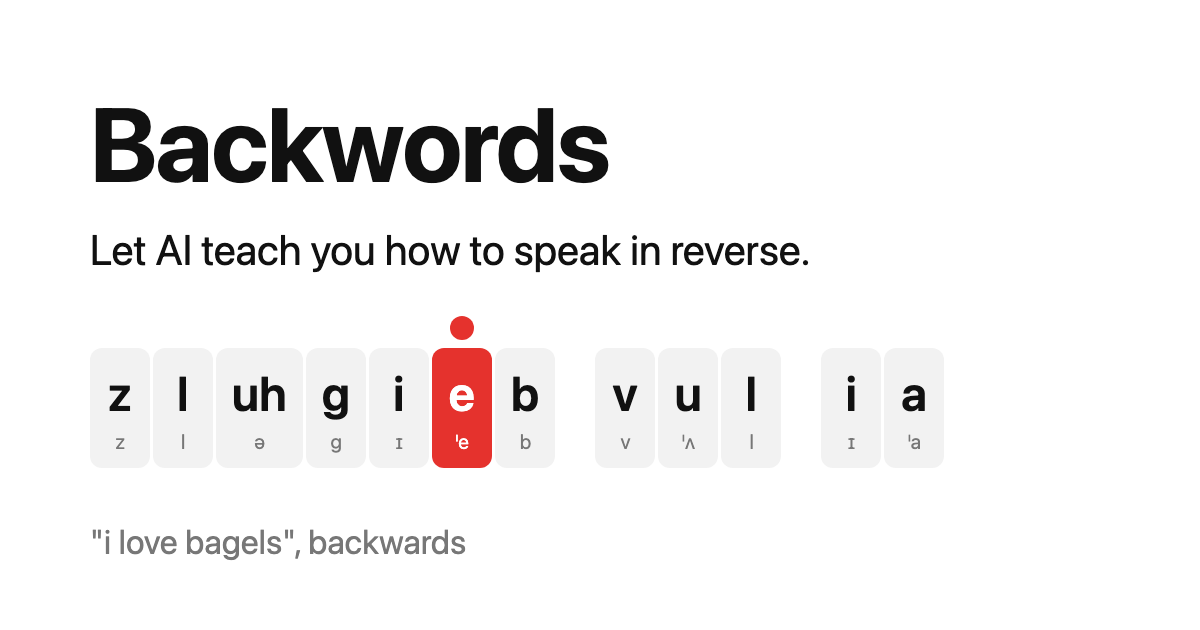
Show HN: Backwords – Let AI teach you how to speak in reverse
A new project called Backwords uses AI to teach users how to speak in reverse, aiming to explore linguistic abilities and the capabilities of AI in language manipulation. This initiative highlights advancements in AI technology and offers an engaging way to understand reverse speech patterns.
Yesterday
Interactive Backdoor Attacks in LLM-Based Proactive Dialogue Systems
A new study warns that fine-tuning large language model (LLM)-based proactive dialogue systems with external data can introduce backdoor vulnerabilities, which existing research has largely overlooked. This matters because such systems are used for goal-directed support and could be exploited if attackers sneak in malicious instructions through the training data.
Follow the Policy, Fail the Benchmark: Auditing and Revising Policy-Based Decision Benchmarks
The study audits nine public policy-based decision benchmarks, revealing that following written rules does not always lead to correct outcomes due to benchmark errors, highlighting the need for revising these benchmarks to better align with actual decision requirements.
Reclassification Is All You Missed: Surfacing Variant Reinterpretation Need in Online Health Communities at Population Scale
A study highlights the inconsistency in recontacting patients when genetic variants are reclassified from uncertain to pathogenic after initial testing, emphasizing the need for clearer responsibilities among laboratories, healthcare providers, and patients. This issue is crucial as it affects patient awareness and management of potential health risks at a population scale.
What Patients Say They Can't Access: Mining Cancer Screening Barriers from Online Communities
A study analyzed online patient discussions to identify barriers to cancer screening access, revealing that existing clinical surveys may overlook significant patient concerns and reasons for low screening rates. This research highlights the need for more comprehensive understanding of patient experiences to address disparities in cancer care.
Adapting LLM Judges to Observed Human Annotation Policy through Soft Prompt Tuning
A study proposes using soft prompt tuning to adapt large language models (LLMs) for judging chatbot responses, aiming to match human annotation policies more closely without the high costs associated with proprietary models. This approach could make automated judgment systems more practical and cost-effective for real-world applications.
SAFE-Teen: Evaluating Chatbot Safety Across Adolescent Mental Health Conversations
A new study evaluates the safety of AI chatbot interactions with adolescents seeking mental health support, highlighting the need for comprehensive assessments as these conversations can span multiple exchanges and vary slightly in content. This research is crucial because it addresses growing concerns about the potential risks associated with using AI for adolescent mental health assistance.
Recursive Sparse Attention: Million-Token Length Extrapolation at Logarithmic Cost
A new method called Recursive Sparse Attention allows for efficient processing of up to one million tokens, significantly reducing computational costs compared to dense attention techniques, thus enabling better handling of longer documents in machine learning models. This breakthrough is crucial as it addresses the scarcity of long training data and improves the scalability of language models.
Archetypal contexts in the neurons of language models: an architecture for intelligence?
Researchers have validated that language models contain archetypal contexts—universal patterns of relationships recognized across various fields—which suggests these models inherently possess a form of generalized intelligence. This finding is significant as it supports the idea that language models could be foundational in developing more intelligent AI systems.
302 of 302 items shown. Sources: 169 days indexed.