Topic: performance
7 stories found
Thursday, November 5, 2026
Matching the Training-Time Weight Rule in Inference-Time Expert Deactivation
Researchers have compared different methods of expert deactivation during inference to understand their impact on model performance, focusing on token routing and weight adjustments. This study is crucial for optimizing the efficiency and effectiveness of large language models without compromising accuracy.
Wednesday, November 4, 2026
AStockArena: Beyond Returns, Can We Entrust Real Capital to the Decisions of Financial Agents?
The article discusses the growing use of large language models in financial trading and questions if current evaluation methods, which focus solely on return metrics, adequately assess the ethical and reliable decision-making capabilities of these agents. This matters because it highlights a potential gap in ensuring that financial decisions made by AI are not only profitable but also responsible.
Monday, November 2, 2026
HyperRepair: Recovering Forgotten General Capabilities of Fine-Tuned Language Models
A new method called HyperRepair has been developed to recover the general capabilities of fine-tuned language models without compromising their specialized performance, addressing the common trade-off faced by existing techniques. This breakthrough could enhance the versatility and reliability of language models across various applications.
Saturday, October 31, 2026
Verification Learning Theory: A Process Model of Checking and Retention in AI-Assisted Judgment
Verification Learning Theory (VLT) suggests that accurate AI assistance can enhance immediate judgments but may reduce the need for practitioners to independently perform necessary operations, potentially impacting their long-term retention and skill maintenance. This theory is crucial as it highlights the balance between leveraging AI for accuracy and ensuring ongoing skill development in judgment tasks.
Monday, October 26, 2026
Phronix: The Capability-Centric Learning Paradigm for Agents
Phronix introduces a capability-centric learning paradigm aimed at enhancing the performance of large language model-based agents in scientific computing tasks. This approach emphasizes the importance of the surrounding harness to improve agent effectiveness, addressing limitations in current methodologies.
Sunday, October 25, 2026
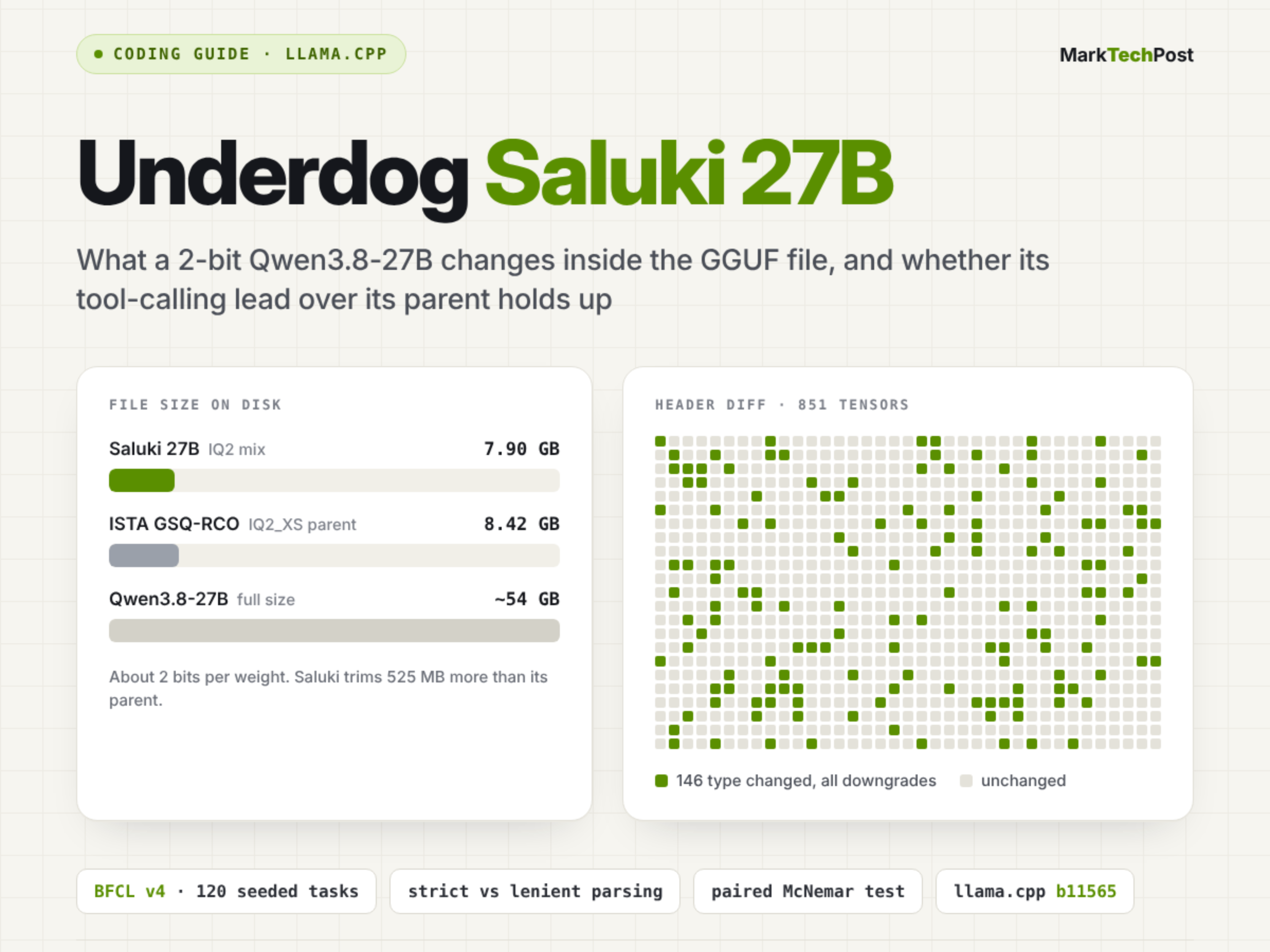
How to Run Underdog Saluki 27B: 2-Bit Qwen3.8-27B Tool-Calling Guide
A coding guide compares Underdog Saluki 27B with ISTA's GSQ-RCO quantization, focusing on GGUF headers, memory usage, and BFCL tool-calling performance in stock llama.cpp. This matters for developers looking to optimize large language models for efficiency and performance.
Wednesday, August 26, 2026
vLLM releases: v0.28.0
vLLM released version 0.28.0 with significant optimizations, including Decode Context Parallel (DCP) support and fused FlashKDA decode and prefill kernels, benefiting from 584 commits by 270 contributors. This update enhances performance, particularly for Kimi-K3, highlighting the community's contribution to the project.
🌿 That's all for now. Come back tomorrow.
7 of 7 items shown. Sources: 169 days indexed.