Topic: small
7 stories found
Today
[AINews] Anthropic IPO: Whither Now?
Innovative AI firm Anthropic plans its Initial Public Offering (IPO), drawing attention as their advanced model Inkling 2 Small passes early safety checks, raising questions about regulatory oversight in the rapidly evolving AI sector.
Yesterday
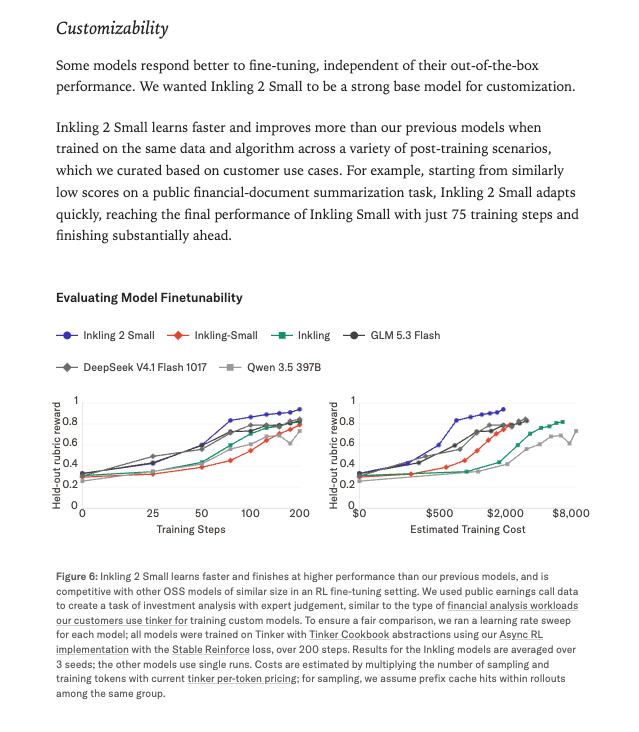
[AINews] Inkling 2 Small: 17A-594B trained in 68 hours on 12T tokens, beating Muse Spark
Inkleing 2 Small was trained in just 68 hours on 12T tokens, outperforming Muse Spark in a recent study by METR, highlighting rapid advancements in AI training efficiency. This achievement underscores the ongoing competition and progress in developing more capable AI models faster.
Thursday, November 5, 2026
SRRM: A Retrieval-Reconstruction Benchmark for Evaluating Long-Context Memory in Small Language Models
A new benchmark called SRRM has been introduced to evaluate the long-context memory capabilities of small language models, addressing the need for better understanding and assessment of these models' abilities to retain information over extended text sequences. This is crucial as SLMs are increasingly used on consumer-grade hardware where handling longer contexts poses significant challenges.
Wednesday, October 28, 2026
ggml/llama.cpp releases: b11945
The ggml/llama.cpp project has updated to include new models LiquidAI/d1-2B and LiquidAI/d1-omni-2B, expanding its model offerings. These updates are significant as they enhance the project's capabilities in handling speech tasks and provide more options for users interested in these specific models.
Tuesday, October 27, 2026
Ollama releases: v0.40.12
Ollama released version v0.40.12, which introduces LFM3, a new set of small models designed for local use and structured output on Liquid's tri-hybrid architecture, marking advancements in AI deployment flexibility.
Monday, October 26, 2026
PaperFormalizer: Author-in-the-Loop Autoformalization of Research Papers in Lean
PaperFormalizer is a new Lean-based tool designed to help researchers identify and correct logical gaps in their papers, transforming them into formally verified documents. This tool matters because it ensures the rigor and reliability of research findings by leveraging formal verification techniques directly within the author's workflow.
🌿 That's all for now. Come back tomorrow.
7 of 7 items shown. Sources: 169 days indexed.