Topic: training
23 stories found
Yesterday
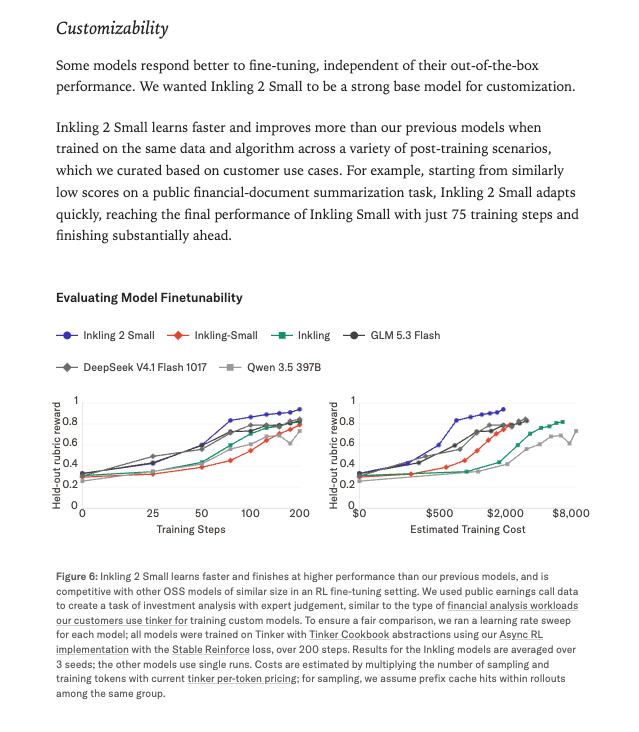
[AINews] Inkling 2 Small: 17A-594B trained in 68 hours on 12T tokens, beating Muse Spark
Inkleing 2 Small was trained in just 68 hours on 12T tokens, outperforming Muse Spark in a recent study by METR, highlighting rapid advancements in AI training efficiency. This achievement underscores the ongoing competition and progress in developing more capable AI models faster.
Recursive Sparse Attention: Million-Token Length Extrapolation at Logarithmic Cost
A new method called Recursive Sparse Attention allows for efficient processing of up to one million tokens, significantly reducing computational costs compared to dense attention techniques, thus enabling better handling of longer documents in machine learning models. This breakthrough is crucial as it addresses the scarcity of long training data and improves the scalability of language models.
Resource-Efficient Reinforcement Learning Post-Training through Elastic Expert Parallelism
A new method in reinforcement learning post-training uses elastic expert parallelism to address the computational bottleneck by allowing idle workers to take on additional tasks, making the process more resource-efficient. This advancement is crucial as it enhances the capabilities of large language models while reducing energy consumption and processing time.
Thursday, November 5, 2026
Matching the Training-Time Weight Rule in Inference-Time Expert Deactivation
Researchers have compared different methods of expert deactivation during inference to understand their impact on model performance, focusing on token routing and weight adjustments. This study is crucial for optimizing the efficiency and effectiveness of large language models without compromising accuracy.
Wednesday, November 4, 2026
Queering the Audits: Community-Based Auditing of AI Harms to Queer Communities
AI systems perpetuate harm to queer communities through biased training data, misclassification, and discrimination, but standard technical audits fail to address these issues effectively. This highlights the need for community-based auditing to better protect queer rights and prevent further marginalization.
Monday, November 2, 2026
Li$^{2}$SAO: Lifting Light Singl-Rollout Asynchronous RL Optimization via Group-Relative Actor-Critic Bootstrapping
A new method called Li$^{2}$SAO aims to enhance asynchronous reinforcement learning optimization for large language models by using a Group-Relative Actor-Critic bootstrapping approach, potentially improving training efficiency. This development is significant as it addresses limitations in current techniques and could lead to more effective post-training processes for LLMs.
Saturday, October 31, 2026
LRMoE: Demand-Side Load Re-Calibration for Efficient MoE Training on Memory-Constrained Nodes
A new method called Demand-Side Load Re-Calibration aims to improve the efficiency of training sparse Mixture-of-Experts (MoE) models on memory-constrained nodes by addressing uneven workload distribution, which is crucial for enhancing performance in Web applications.
Friday, October 30, 2026
Making it easier for websites to express AI training preferences
OpenAI introduced a new protocol allowing websites to use a shared robots.txt signal to indicate their preference regarding AI training, simplifying communication between site owners and AI service providers. This initiative aims to respect website operators' wishes more efficiently, enhancing privacy and content control in the age of advanced AI technologies.
Thursday, October 29, 2026

Prime Intellect Releases Prime Mega MoE: Trainable Fused MoE Kernel, 3.11x Faster Forward Pass
Prime Intellect released Prime Mega MoE, a trainable version of the fused Mega MoE kernel that accelerates Qwen3 MoE training by up to 34%, making deep learning model development more efficient.
Wednesday, October 28, 2026
ReCoPII: A Relation-Grounded Framework for Building Contextual PII Masking Datasets
A new framework called ReCoPII has been developed to create contextual PII masking datasets by using relation-grounded author-based augmentation, addressing the challenge of limited real-data access for training masking systems in privacy-sensitive contexts.
23 of 23 items shown. Sources: 169 days indexed.